

For my first few weeks of training I changed my workout every time I got bored. A new video, a new set of exercises, a new plan from someone online. I called it variety. It was really me avoiding the dull part, which is doing the same thing until it gets easier.
What finally stopped it was money. I couldn't afford a gym membership, so I had one pair of adjustable dumbbells, a chair and a patch of floor. There was nothing left to switch to. I wrote down one plan, three days a week, and stuck with it.
This is that plan. It isn't perfect, and dumbbells on their own have real limits that I'll get to. But if you're starting out, short on cash, and want something you can repeat on Monday morning without thinking, here it is.
At a glance
- Level
- Beginner
- Days per week
- 3 (Mon, Wed, Fri)
- Time per session
- About 45 minutes
- Equipment
- Dumbbells, a sturdy chair
Not for you if you have an injury, a medical condition, a pregnancy or an extreme diet in the picture. See a doctor or qualified professional first. It also won't suit experienced lifters, who will outgrow dumbbells fast. This is educational content, not medical advice.
On this page
The weekly schedule
Three training days, four days off. Every session covers your whole body, so a missed day doesn't leave a muscle group sitting out for the week. The 2020 World Health Organization guidelines ask adults to do muscle-strengthening work at moderate or greater intensity, covering all the major muscle groups, on at least two days a week1. Three sessions leaves you one spare.
Each session takes about 45 minutes. Spend the first five warming up: march on the spot, do some arm circles and a few bodyweight squats, then one light set of your first exercise. After that it's five or six exercises with two or three sets each, mostly in the 8 to 15 rep range. The exact numbers are on each day's card below.
Rest was where I cheated early on. I'd glance at the clock, take 30 seconds, and wonder why my second set felt so much worse than my first. In one study of 21 trained men, resting three minutes between sets produced bigger gains in strength and muscle thickness over eight weeks than resting one minute2. I can't give you three minutes after every set and still finish in 45 minutes, so I settled on about 90 seconds for the big lifts and 60 for the small ones. If your reps fall off a cliff on the next set, rest longer. Finishing your sets with the same weight matters more than finishing fast.
Why this approach works
I like reviews that pool many studies, because any single small study can mislead. Here's what they say about the choices in this plan.
Frequency first. A 2016 review found that training a muscle twice a week beat once a week when total work was matched3. A later review looked at the question again and found that when total sets are equal, the number of days you spread them across seems to matter much less4. My takeaway is that the weekly set count does most of the work, and three full-body days is a comfortable way to fit those sets in.
Volume next. A meta-regression of 15 studies found a graded pattern: more weekly sets per muscle went with more muscle growth, and the authors concluded that around ten or more weekly sets per muscle looked best5. It also found real gains from four or fewer weekly sets, which is good news if your time is short5. Many of those studies involved people newer to training, and nobody knows exactly where the ceiling sits. In this plan most muscles get roughly 5 to 10 hard sets a week. Chest sits at the low end, and I'll show you how to add to it.
Then load. A review of 21 studies compared lighter loads (60 percent of your one-rep max or less) with heavier ones, with every set taken to failure. Heavier loads built more maximal strength, but muscle growth looked similar across the range6. That's the main reason I'm comfortable building a muscle plan around dumbbells that would look light in a gym.
The catch is effort. A 2024 meta-regression found that muscle growth improved as sets ended closer to failure, while strength gains looked similar across a wide range of effort7. The authors point out that the reps left in reserve were estimated rather than measured, so treat it as a direction and not a precise rule. I use it like this: finish most sets with about one to three reps still in the tank.
These numbers are averages from controlled studies, many of them in young men, and your results will differ. Nothing here guarantees a particular change in your body. The research on exact set counts and how close to push to failure is still being refined.
Day 1 (Monday): Squat and push
Monday starts with the biggest muscles in the plan, because that's when you're freshest. One squat, one press, one row and one hinge covers your whole body in a single session. I put the squat first since it takes the most out of me, and I'd rather spend that energy early.
Squat and push
| # | Exercise | Sets | Reps | Rest |
|---|---|---|---|---|
| Goblet squatHold one dumbbell against your chest and sit down between your hips. | 3 | 10 to 12 | 90 sec | |
| Dumbbell floor pressLie on the floor with knees bent. Lower until your elbows touch the floor, then press up. | 3 | 8 to 12 | 90 sec | |
| One-arm dumbbell rowOne hand on a sturdy chair seat. Pull the dumbbell toward your hip. | 3 | 10 to 12 each side | 90 sec | |
| Dumbbell Romanian deadliftSoft knees, hips pushed back, dumbbells sliding down your thighs. | 2 | 10 to 12 | 90 sec | |
| Standing dumbbell shoulder pressRibs down, squeeze your glutes, press straight overhead. | 2 | 8 to 12 | 60 sec | |
| PlankForearms on the floor, body in one straight line. | 2 | 30 sec hold | 60 sec |
Why these exercises?
The goblet squat is the easiest way I know to learn a squat with one dumbbell. Holding the weight in front of you pulls your torso upright, and your whole lower body has to work. The floor press stands in for the bench press. The floor stops your elbows from dropping too far, which is kinder to cranky shoulders, and you don't need a bench at all.
The one-arm row with a hand on a chair balances the pressing, so your upper back gets as much attention as your chest. Romanian deadlifts teach the hip hinge, the movement behind picking things up without rounding your back. The shoulder press and plank round out the session. Add up the week and every big muscle gets several hard sets, which is what the volume research points to5.
Put the chair against a wall so it can't slide, and test that it holds your weight before you lean on it. A wobbly chair is the quickest way to ruin a good session.
Day 2 (Wednesday): Hinge and pull
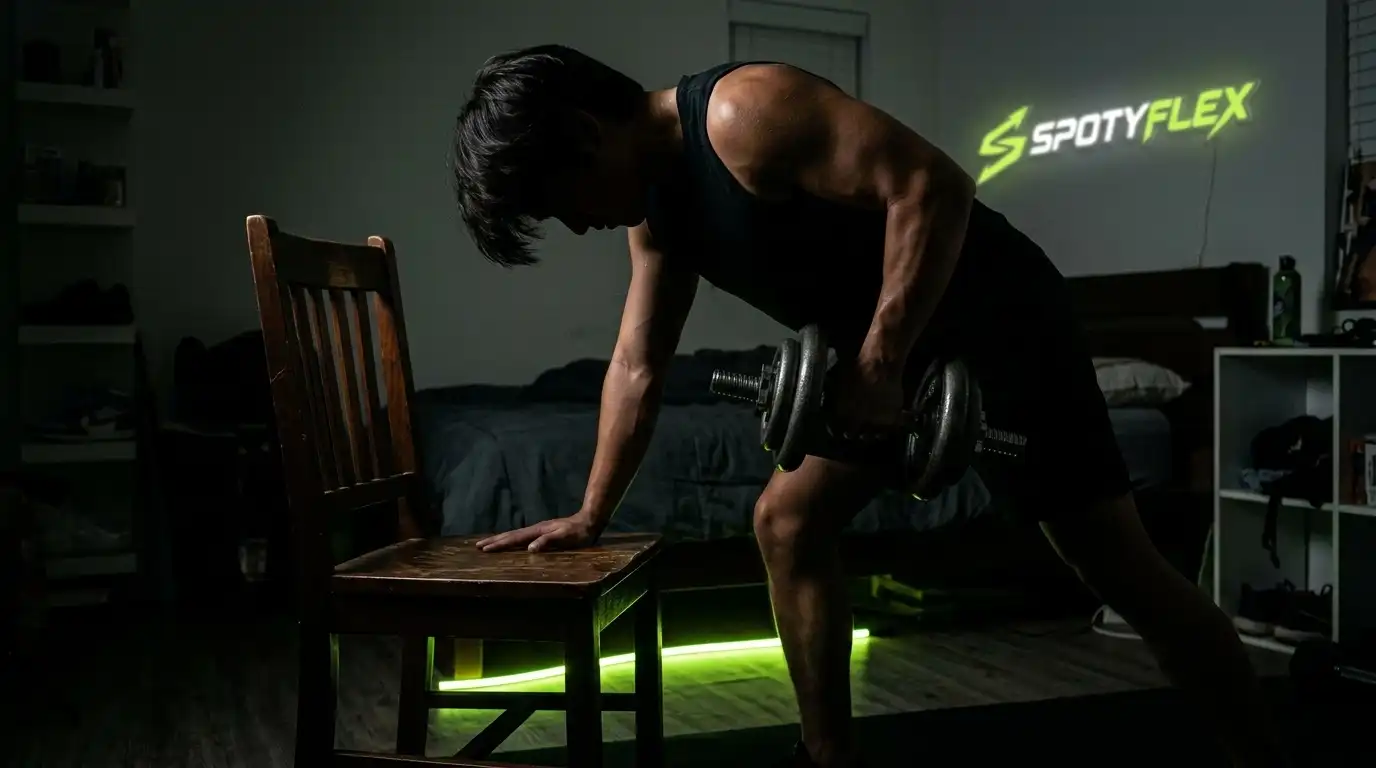
Wednesday flips the emphasis. The hinge and the pulling come first, and lunges take over most of the quad work. Doing the hinge first on this day means your hamstrings and glutes get a proper session at the start of the workout instead of what's left over.
Hinge and pull
| # | Exercise | Sets | Reps | Rest |
|---|---|---|---|---|
| Dumbbell Romanian deadliftUse the heaviest pair you can control. Back flat, hips back. | 3 | 8 to 12 | 90 sec | |
| Two-arm bent-over rowHinge forward, pull both dumbbells toward your hips. | 3 | 10 to 12 | 90 sec | |
| Dumbbell reverse lungeStep back, lower the back knee toward the floor, push through the front heel. | 3 | 8 to 10 each leg | 90 sec | |
| Neutral-grip floor pressSame as Monday, but with your palms facing each other. | 2 | 8 to 12 | 90 sec | |
| Dumbbell biceps curlElbows by your sides, lower slowly. | 2 | 10 to 15 | 60 sec | |
| Farmer carryWalk tall with a heavy dumbbell in each hand. | 2 | 30 sec walk | 60 sec |
Why these exercises?
The Romanian deadlift shows up again because the best way to get better at a movement is to repeat it. Doing it first on Wednesday lets you use more weight than you would at the end of Monday's session. The two-arm row loads your upper back with both hands at once, which usually means you can handle more total weight than with one-arm rows.
Reverse lunges are easier on your balance than walking lunges, and because you train one leg at a time, a pair of dumbbells that feels light for two legs often feels heavy for one. That's one of the best tricks in dumbbell-only training. The curl is there because I enjoy it, and most of your arm work already comes from the rows. The farmer carry costs nothing and trains your grip and trunk.
The rep ranges here run from 8 to 15. The load review found muscle growth looked similar with lighter and heavier weights when sets were taken to failure6, so choose the weight that makes the last couple of reps hard and don't chase a number.
If the dumbbells for the farmer carry are the heaviest you own, take short steps and walk slowly. Put them down before your grip gives out instead of dropping them on your feet.
Day 3 (Friday): Single leg and press

Friday leans on one-leg work and pressing overhead. One-leg exercises are where dumbbell-only training really earns its keep. The same pair that felt too light for a squat can feel brutal in a split squat.
Single leg and press
| # | Exercise | Sets | Reps | Rest |
|---|---|---|---|---|
| Dumbbell split squatFeet in a long stride, lower straight down. Keep a wall or chair nearby for balance. | 3 | 8 to 10 each leg | 90 sec | |
| Standing dumbbell shoulder pressPress straight overhead without leaning back. | 3 | 8 to 12 | 90 sec | |
| Dumbbell glute bridgeLie on your back with a dumbbell across your hips (a folded towel helps). Drive your hips up. | 3 | 10 to 15 | 90 sec | |
| One-arm dumbbell rowSame as Monday. Try for a slower lowering this time. | 3 | 10 to 12 each side | 90 sec | |
| Dumbbell lateral raiseLight weight, slight bend in the elbows, lift out to shoulder height. | 2 | 12 to 15 | 60 sec | |
| Overhead dumbbell triceps extensionHold one dumbbell with both hands, lower it behind your head, then straighten your arms. | 2 | 10 to 15 | 60 sec |
Why these exercises?
Split squats hit your quads and glutes one side at a time, so the weight you own goes further. The glute bridge needs no bench, just the floor, and it works your glutes without asking much of your lower back. Shoulder pressing and rows come around again too, so those muscles get trained on more than one day.
Lateral raises and triceps extensions train small muscles, so light weights are fine. These are also the safest places in the plan to push close to failure, since there's little balance to lose. That matters because growth improved as sets ended closer to failure in the 2024 analysis7.
A muscle burning is one thing. Sharp or pinching pain in a joint is another. If you feel it, stop that exercise, and see a doctor or physiotherapist if it keeps coming back. Pushing through it won't make you tougher.
How to progress
Muscles grow when the work gets a bit harder than what they already handle. That's progressive overload, and it's the reason writing things down matters. With dumbbells you have four levers: more weight, more reps, more sets, or better control on every rep. Most beginners only think about the first one. With a limited set of dumbbells, it's also the lever that runs out first.
The simple progression rule
Every exercise has a rep range on its card. Start with a weight that lets you reach the bottom of the range with about two reps left. Each session, try to add a rep or two. When you hit the top of the range on every set and the last rep still looks clean, move up to the next dumbbell. You're back at the bottom of the range, and that's fine. This is the rule I used. It doesn't come from a specific study. It's just simple enough to follow when you're tired.
Write down the weight and reps for every set, on paper or in a notes app. I used to tell myself I'd remember last week's numbers, and I never did. A log also shows you when you've been stuck for three sessions, which is your cue to change something.
When your dumbbells get too light
This is the real weak spot of a dumbbell-only plan, and it shows up in the legs first. Before you buy anything, try these:
- Slow the lowering. Take three seconds to come down on every rep.
- Add a pause. Hold one second at the bottom of squats, lunges and rows.
- Go one leg at a time. Swap goblet squats for split squats or reverse lunges.
- Add reps. Keep going until you have one or two reps left.
- Add a set. One extra set on the muscle that's lagging.
Ending sets closer to failure is the lever I trust most. The load review found similar muscle growth with lighter and heavier weights6, and the 2024 analysis found growth improved the nearer sets ended to failure7. The same load review also found that heavier weights built more maximal strength6. So if raw strength is your goal, you'll eventually need heavier dumbbells or a barbell somewhere, and I won't pretend otherwise.
Common beginner mistakes
Changing the plan every week
This was me. A new workout always feels more productive because everything's unfamiliar and you get sore. But you can't tell whether something works if you never repeat it. Give this plan at least eight weeks before you judge it.
Stopping sets far too early
I used to end a set when it started to feel uncomfortable, which is usually several reps before the muscle is truly tired. Growth tends to improve as sets end closer to failure7. Try finishing each set with one to three clean reps still available. If your form breaks down, that set is over.
Rushing the rest
Short rests feel hardcore. The study I mentioned earlier found that longer rests did better than short ones in trained men2. I'd rather you rest 90 seconds and hit your reps than rest 30 and watch them fall.
Treating soreness as the score
Some soreness in the first couple of weeks is normal for many people. It doesn't tell you whether a workout was good, and some of my best sessions left me feeling fine the next day. Judge the plan by your log, with weights and reps creeping up.
How long to run the program
I'd run it for 8 to 12 weeks before changing anything big. That's 24 to 36 sessions, enough to repeat every exercise many times and watch the numbers in your log move. There's no magic number. I picked this range because it's long enough to judge and short enough to stay interested.
After that, adjust. If a muscle feels behind, add one set to it on a day when you have energy. For chest I'd add a set of floor presses on Day 3. If your dumbbells are too light for your legs, swap goblet squats for split squats on Day 1. If you feel drained all the time, drop a set from each exercise for a week. And if you've outgrown your dumbbells, that's a good problem. It's time to look at heavier weights or a gym.
I never needed a perfect plan. I needed one I'd repeat on a Monday morning when I didn't feel like it. If an exercise doesn't agree with you, change that one and keep the rest.
FAQ
Do I need a bench?
No. The floor press and glute bridge are done on the floor, and a sturdy chair supports the one-arm row. A bench would give you more options later, but nothing in this plan needs one.
What if I only own one pair of dumbbells?
Use that pair for the exercises where it feels right and make the rest harder another way: slower lowering, pauses, one-leg versions and sets that end closer to failure. Adjustable dumbbells solve this neatly if you can ever afford a pair, but start with what you have.
How long until I see results?
It varies from person to person, and I can't promise a timeline. Many people notice that exercises feel easier and they can lift more before anything changes in the mirror. Trust your log first.
What if I miss a workout?
Do it on the next day you're free and shift the rest of the week, keeping a rest day between sessions when you can. If you miss it entirely, skip it and carry on. Don't double up. Two sessions in a week still meets the muscle-strengthening part of the WHO guidelines1.
Is soreness normal, and when should I worry?
Some soreness in the first weeks is common and usually eases as you repeat the workouts. Sharp pain, pain in a joint, swelling, or pain that keeps getting worse is a reason to stop and see a doctor or physiotherapist. Severe muscle pain with very dark urine needs urgent medical attention.
Can I swap exercises?
Yes, as long as you keep the movement pattern. Swap one squat for another squat, or one row for another row. If an exercise hurts, replace it with something close that doesn't, and see a professional if the pain returns. Try not to swap more than one or two at a time, or you're back to changing the plan every week.
Next step
You'll get more from this plan if you write every set down. Grab the workout log template and take it to your first session.
Get the workout logReferences
View all 7 references
- Bull FC, Al-Ansari SS, Biddle S, Borodulin K, Buman MP, Cardon G, et al. World Health Organization 2020 guidelines on physical activity and sedentary behaviour. Br J Sports Med. 2020;54(24):1451 to 1462. PubMed
- Schoenfeld BJ, Pope ZK, Benik FM, Hester GM, Sellers J, Nooner JL, Schnaiter JA, Bond-Williams KE, Carter AS, Ross CL, Just BL, Henselmans M, Krieger JW. Longer interset rest periods enhance muscle strength and hypertrophy in resistance-trained men. J Strength Cond Res. 2016;30(7):1805 to 1812. PubMed
- Schoenfeld BJ, Ogborn D, Krieger JW. Effects of resistance training frequency on measures of muscle hypertrophy: a systematic review and meta-analysis. Sports Med. 2016;46(11):1689 to 1697. PubMed
- Grgic J, Schoenfeld BJ, Latella C. Resistance training frequency and skeletal muscle hypertrophy: a review of available evidence. J Sci Med Sport. 2019;22(3):361 to 370. PubMed
- Schoenfeld BJ, Ogborn D, Krieger JW. Dose-response relationship between weekly resistance training volume and increases in muscle mass: a systematic review and meta-analysis. J Sports Sci. 2017;35(11):1073 to 1082 (published online 2016). DOI
- Schoenfeld BJ, Grgic J, Ogborn D, Krieger JW. Strength and hypertrophy adaptations between low- vs. high-load resistance training: a systematic review and meta-analysis. J Strength Cond Res. 2017;31(12):3508 to 3523. PubMed
- Robinson ZP, Pelland JC, Remmert JF, Refalo MC, Jukic I, Steele J, Zourdos MC. Exploring the dose-response relationship between estimated resistance training proximity to failure, strength gain, and muscle hypertrophy: a series of meta-regressions. Sports Med. 2024;54(9):2209 to 2231. DOI