

For a long time my leg day was three sets on the leg press, a quick stretch, and then I went home feeling like I’d done my part. I hadn’t. My legs looked like they belonged to someone who skipped legs, because I basically had.
The leg press isn’t the problem. It’s a good exercise. The problem was that it was the only thing I did, so my hamstrings, glutes and calves got almost nothing. This is the single leg day I’d hand to my past self: six exercises, one session, a full gym, and no complicated tricks.
- Who it’s for: beginners to intermediates with access to a full gym
- Days per week: one leg day (you keep your other training as it is)
- Session length: about 60 to 70 minutes including rest
- Equipment: barbell and rack, leg press, seated leg curl machine, dumbbells, calf raise station or Smith machine
Not for you if... you have knee, hip or lower back pain, a recent injury or surgery, you are pregnant or breastfeeding, or you have a medical condition that affects exercise. Talk to a doctor or physiotherapist first. This is education, not medical advice.
In this article
My Weekly Setup
You only need to add one day. I put legs on Tuesday so I’m fresh for the heavy lifts, and I keep a rest day or an easy day before and after it. Your other days stay whatever you already do.
Each exercise gets three sets, a rep range, and a rest time. Pick a weight that leaves you about two reps short of failure on the last set. If you’re new to a lift, start lighter than you think you need to. Learning the movement comes first.
Why This Approach Works
Muscles grow in response to enough hard work over time. A review of 15 studies found that doing more weekly sets per muscle tended to produce more growth, with 10 or more sets per muscle doing best.[1] This leg day gives your quads about 9 hard sets. Your hamstrings get fewer, so if you want to build them faster later, that’s where I’d add sets first.
Then there’s range of motion. I used to load the leg press with a ridiculous weight and move it a few inches. A systematic review of 11 studies suggests that training through a full range, or in the long, stretched part of the movement, is a good bet for quads, and full range did better than partials at the top for glutes and adductors.[2] Moving through depth you can control beats a heavier number you can’t.
Most of this research is on young, healthy adults, often men, over a few weeks to a few months. It points in a direction. It doesn’t guarantee your result.
The Leg Day
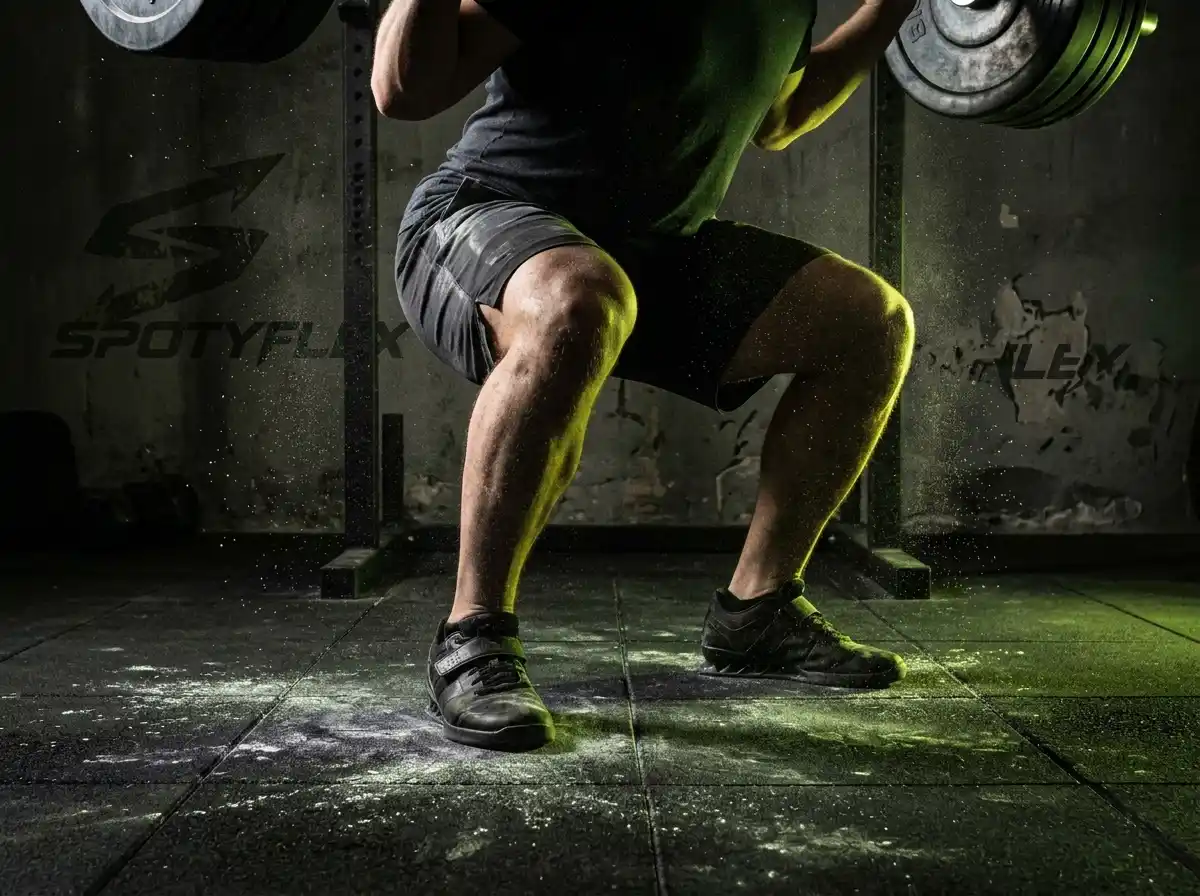
I pair these on purpose. Squat and leg press carry the quads and glutes. The Romanian deadlift and leg curl cover the back of the leg, which is the part I ignored. Split squats fix left and right differences, and calves finish the job. Do them in this order, with the heaviest and most technical first.
| # | Exercise | Sets | Reps | Rest |
|---|---|---|---|---|
| 1 | Barbell back squat | 3 | 6 to 8 | 2 to 3 min |
| 2 | Romanian deadlift | 3 | 8 to 10 | 2 to 3 min |
| 3 | Leg press | 3 | 10 to 12 | 2 min |
| 4 | Seated leg curl | 3 | 10 to 12 | 90 sec to 2 min |
| 5 | Dumbbell split squat | 3 | 8 to 10 each leg | 2 min |
| 6 | Standing calf raise | 3 | 12 to 15 | 90 sec |
Warm up with a few light sets of the squat before your working sets. If you’d like a full routine, I wrote one in my warm-up guide.
Why these exercises?
Squat and leg press both train the quads through a big range. I keep both because the squat teaches me to brace and balance, while the leg press lets me push close to failure without worrying about falling over. Depth matters more than the plates on the bar.[2]
Romanian deadlift loads the hamstrings and glutes while they’re stretched, because you push your hips back and keep the knees soft. Think of closing a car door with your hips. Stop when your back would round, not when the bar hits the floor.
Seated leg curl is here for one reason. In a 12-week study of 20 healthy adults, the seated version grew the whole hamstring group about 14%, compared with about 9% for the lying version, probably because the hamstrings are more stretched when you sit.[3] If your gym only has the lying one, use it. It still works.
Split squats catch the imbalance between legs, and calf raises are slow on purpose. Pause at the bottom, rise all the way up, and don’t bounce.
Rest longer than feels necessary on the first three exercises. In an 8-week study of 21 trained young men, resting 3 minutes between sets produced more thigh growth and more leg strength than resting 1 minute.[4] Beginners may need less, but if you’re rushing through your squats, slow down.
Progression
Your legs only grow if the work gets a little harder over time. That’s progressive overload, and it’s the whole point of writing numbers down. I explain more in my progressive overload guide.
The simple rule
Stay in the rep range. When you hit the top number on all three sets with good form, add a small amount of weight next time and start back at the bottom of the range. That’s it. Heavier loads and lighter loads can both build muscle, so the exact rep number matters less than working hard close to failure.[5]
Write down weight, reps and how hard the last set felt. I use my phone notes. If you can’t remember what you lifted last week, you’re guessing.
Common Beginner Mistakes
Cutting the depth to lift heavier
I did this a lot. The bar felt impressive and my legs got little out of it. Lower the weight until you can reach a depth you control.[2]
Ignoring the hamstrings
If every exercise is a squat or a press, the back of your leg gets left behind. That’s why the Romanian deadlift and leg curl are not optional.
Rushing the rest
Short rests felt more “hardcore.” They also meant I did fewer good reps on the next set.[4]
Swapping exercises every week
Boredom is real, but a review of eight studies found some planned variation can help, while constant random changes may hurt your gains.[6] Keep the same six for a few weeks before you change anything.
How Long to Run the Program
Give it 8 to 12 weeks. After that, look at what changed. If your squat and leg press numbers went up, keep going. If you’re stuck for three weeks in a row, check your sleep, food and how hard the last set really was before you blame the program.
When you’re ready, add one set to the hamstring exercises, or a second lighter leg day. If your knees or back hurt, stop and see a doctor or physiotherapist.
You don’t need a perfect leg day. You need one you’ll actually show up for, every week, with all six exercises done properly.
FAQ
Is one leg day a week enough?
It’s a solid start, especially if you’re new. More weekly sets tend to give more growth,[1] so a second, lighter leg session later is a reasonable next step.
I can’t squat comfortably. What now?
Use a goblet squat with a dumbbell or just do more leg press and split squats. If squatting hurts, see a doctor or physiotherapist rather than pushing through.
How heavy should I go?
Heavy enough that the last set leaves you about two reps short of failure, with clean form. Add weight slowly.
Why do I walk funny for two days?
That’s normal soreness, especially the first few weeks. I wrote about it in what I wish someone told me about sore muscles.
Can I swap leg press for hack squat?
Yes. Any machine that lets you reach a deep, controlled range works fine.
Done with legs? Here’s the upper body counterpart I wrote for the back.
Read the back workoutReferences
- Schoenfeld BJ, Ogborn D, Krieger JW. Dose-response relationship between weekly resistance training volume and increases in muscle mass: a systematic review and meta-analysis. J Sports Sci. 2016 (online), pp. 1073 to 1082. PubMed 27433992. DOI: 10.1080/02640414.2016.1210197
- Kassiano W, Costa B, Nunes JP, Ribeiro AS, Schoenfeld BJ, Cyrino ES. Which ROMs lead to Rome? A systematic review of the effects of range of motion on muscle hypertrophy. J Strength Cond Res. 2023;37(5):1135-1144. PubMed 36662126
- Maeo S, Huang M, Wu Y, et al. Greater hamstrings muscle hypertrophy but similar damage protection after training at long versus short muscle lengths. Med Sci Sports Exerc. 2021;53(4):825-837. PubMed 33009197
- Schoenfeld BJ, Pope ZK, Benik FM, et al. Longer interset rest periods enhance muscle strength and hypertrophy in resistance-trained men. J Strength Cond Res. 2016;30(7):1805-1812. PubMed 26605807
- Schoenfeld BJ, Grgic J, Van Every DW, Plotkin DL. Loading recommendations for muscle strength, hypertrophy, and local endurance: a re-examination of the repetition continuum. Sports (Basel). 2021;9(2):32. PubMed 33671664. DOI: 10.3390/sports9020032
- Kassiano W, Nunes JP, Costa B, Ribeiro AS, Schoenfeld BJ, Cyrino ES. Does varying resistance exercises promote superior muscle hypertrophy and strength gains? A systematic review. J Strength Cond Res. 2022;36(6):1753-1762. PubMed 35438660