


For a long time I skipped core work, and I had a whole speech ready to defend it. Abs are made in the kitchen. Squats and deadlifts already train your middle. Nobody ever got strong lying on the floor doing crunches.
Some of that is true, and I'll get to which parts. But I was using the speech as cover. The real reason was simpler: ab work felt boring, it burned in a way I didn't like, and there was no bar to load and watch the numbers climb. So I'd finish my last heavy set, glance at the mat in the corner, and go home.
I wish I'd stopped dodging it sooner. Once I started doing short, slow core sessions, my lifts felt steadier. What I hated was the old routine of 100 crunches at the end of a tired workout, and I never gave core training a fair try. This plan is the version I wish someone had handed me: three sessions a week, about 12 minutes each, and only a mat.
At a glance
Not for you if... you're pregnant or postpartum, recovering from abdominal surgery or a hernia, or have back pain that spreads into a leg or comes with numbness. See a doctor or physiotherapist first.
Educational content, not medical advice.
Your weekly schedule
Here's the whole week at a glance. Three short sessions with a rest day between each, so your core has time to recover. On the other days, do whatever you normally do: lifting, walking, a sport. Tap a training day to jump to it.
Each session has four moves, 2 to 3 sets each, with 30 to 40 seconds of rest. Counting the time it takes to get down on the mat, that lands at about 12 minutes. Spend a minute or two warming up first. I covered a simple routine in my warm-up guide.
The numbers in the tables are starting points. If a set feels easy and your form stays clean, good. If your form falls apart halfway through, end that set there and rest.
Muscle burn is fine. Sharp pain, pain in your lower back that builds as you go, or numbness is a reason to stop and have a doctor or physiotherapist take a look.
Why this approach works
Let me start with the belly fat question, because it's the reason I skipped abs for so long. In one randomized trial, 24 healthy adults did seven ab exercises, five days a week, for six weeks. Compared with a control group, their body fat, waist size and skinfold measurements didn't change.1 A separate trial followed 40 overweight women for 12 weeks and found that adding ab training to a diet didn't shrink belly fat any more than the diet alone.2 So my old speech had a point: crunching doesn't burn the fat that sits on top of your abs. If a leaner waist is the goal, the food side matters more, and I walked through it in the calorie deficit guide.
Here's where my speech fell apart. In that same six-week study, the ab group could do far more curl-ups at the end than the control group (47 compared with 32 on average).1 The muscles got better at their job even though the fat didn't move. Getting better at the job is the whole point of training your core, and it's why I'd do it even if it never changed my waistline.
The World Health Organization's adult guidelines recommend muscle-strengthening activity that works all the major muscle groups on two or more days a week.3 This plan doesn't replace that, since it only covers your middle. Treat it as a short add-on to your other training.
What also changed my mind was how core training should look. Spine researcher Stuart McGill has argued that training the core well means training it differently from the muscles in your arms and legs.4 That's my reason for building this plan around slow moves and holds instead of fast, high-rep crunching. That part is my own takeaway, not his.
People also ask about back pain, so here's the honest version. A meta-analysis of five trials in people who already had chronic low back pain found that core stability exercise reduced pain and disability more than general exercise in the short term, with no clear difference at 6 and 12 months.5 A larger review of 29 studies concluded that stabilisation exercises aren't more effective than other kinds of active exercise in the long term.6 My read: core work is a reasonable tool, and it isn't a cure. If you have back pain, check with a professional before you start.
The studies above measured different things: fat loss, muscle endurance and back pain. A result in one area doesn't carry over to the others, so I've kept each claim to what that study actually measured.
Day 1: Foundations
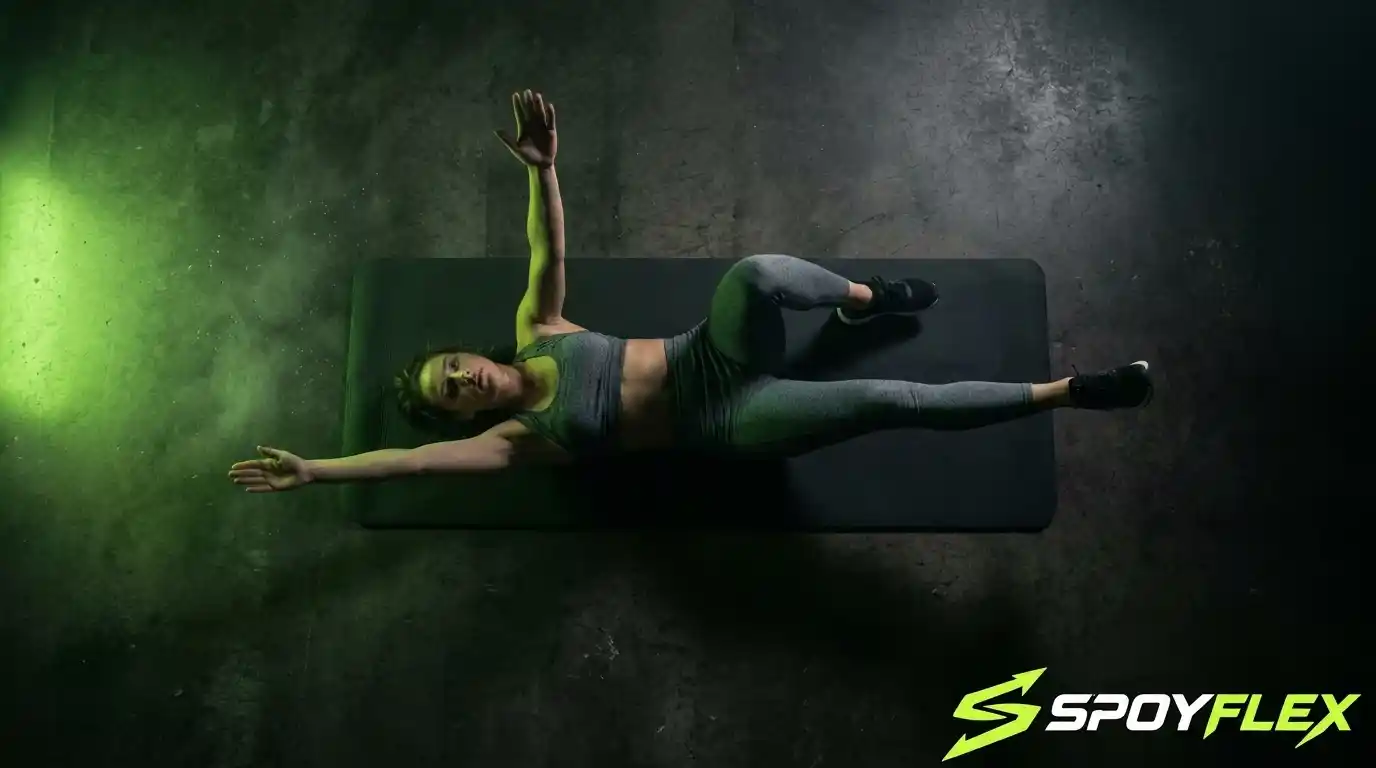
Day 1 is about keeping your trunk still while your arms and legs move. That sounds easy and feels surprisingly hard, which is why it comes first. Go slowly. If a rep is quick, it doesn't count.
Tap an exercise to check it off while you train.
| # | Exercise | Sets | Reps or time | Rest |
|---|---|---|---|---|
| 1 | Dead bugLie on your back, knees over hips, arms pointing at the ceiling. Slowly lower one arm and the opposite leg toward the floor, then return. Keep your lower back resting gently on the floor. | 2 | 6 per side | 30 s |
| 2 | Forearm plankElbows under shoulders, glutes squeezed, ribs pulled down. Your body makes one straight line from head to heels. | 3 | 20 s | 30 s |
| 3 | Bird dogOn hands and knees, reach one arm forward and the opposite leg back, slowly. Keep your hips level, like you're balancing a cup on your lower back. | 2 | 6 per side | 30 s |
| 4 | Reverse crunchLie on your back with knees bent over your hips. Curl your pelvis a few centimeters off the floor, then lower slowly. No swinging. | 2 | 8 reps | 30 s |
Why these exercises?
The dead bug asks your abs to hold your lower back steady while your arms and legs move away from your body. In an ultrasound study of 44 healthy women, it produced a bigger increase in the thickness of the transversus abdominis (a deep abdominal muscle) than four other popular trunk-Pilates exercises, including the side plank.7 That's one small study, so I wouldn't treat it as the final word, but it matches how the move feels: you can't rush it.
The plank and the bird dog follow the same idea. You hold a position and stay in control. The reverse crunch is the one move here that actually curls your trunk, and doing it slowly keeps momentum out of it.
Breathe out as your arm and leg move away from you. If your lower back lifts off the floor, shorten the range until it stays down.
Day 2: Sides and control

Day 2 adds the sides of your trunk. Those muscles stop you from folding or leaning to one side, and they're easy to forget if you only ever crunch forward. The side plank is the main event.
| # | Exercise | Sets | Reps or time | Rest |
|---|---|---|---|---|
| 1 | Side plankElbow under your shoulder, knees bent if you need them. Lift your hips so your body makes a straight line from knees (or feet) to head. | 2 | 15 s per side | 30 s |
| 2 | Dead bug, slowerSame move as Day 1. Take about three seconds to lower and three seconds to return. | 2 | 8 per side | 30 s |
| 3 | Bird dog with a pauseHold the reach for three seconds before you come back. Keep your hips from twisting. | 2 | 6 per side | 30 s |
| 4 | Reverse crunchSlow on the way down. Keep your neck and shoulders relaxed. | 2 | 10 reps | 30 s |
Why these exercises?
I kept the dead bug and the bird dog on purpose, just slower. Doing the same few moves with better control teaches you more than switching to something new every session. The side plank trains the sides of your trunk to keep you level, which matters whenever you carry a heavy bag in one hand or do anything one-sided. If a full side plank is too much, bend your knees and keep your hips up.
If your shoulder complains in a side plank, check that your elbow sits directly under it. If the pain is sharp, stop and get it looked at.
Day 3: Level up

Day 3 is harder and still short. By now the first two days should feel familiar, so this is where you lengthen the lever and slow things down.
| # | Exercise | Sets | Reps or time | Rest |
|---|---|---|---|---|
| 1 | Long-lever plankWalk your elbows out in front of your shoulders, squeeze your glutes and keep your ribs down. Stop the set when your lower back starts to sag. | 3 | 15 to 20 s | 40 s |
| 2 | Dead bug, straighter legsLower the leg further out, as long as your lower back stays down. | 2 | 6 per side | 30 s |
| 3 | Side plankSame as Day 2, a little longer. Keep your top hip stacked over the bottom one. | 2 | 20 s per side | 30 s |
| 4 | Hollow hold, knees bentOn your back, lift your shoulders and feet a little off the floor with knees bent and your lower back pressed down. Hold, keep breathing, then lower. | 2 | 10 to 15 s | 40 s |
Why these exercises?
One research team compared a regular forearm plank with a version that uses a longer lever (elbows out in front of the shoulders) and a tilted pelvis. The modified plank produced more activity in the upper rectus abdominis, the lower abdominal stabilizers and the external oblique than the regular plank, and the longer lever accounted for more of the difference than the tilt did.8 I only use the long-lever part, because it's easier to get right on your own.
The hollow hold and the straighter-leg dead bug follow the same logic: the further your limbs reach from your body, the harder your middle has to work to stay still. That logic is mine, and the plank study is the only direct evidence I'm leaning on here.
Shorten the lever the moment your lower back sags or your ribs flare. A shorter plank done well beats a longer one done badly.
How to make it harder
Your core is made of muscles like any other, so it responds to the same idea: do a little more over time. You can't add plates to a plank, so you change something else. For holds, add a few seconds. For reps, add one or two per side. When both feel easy and clean, move to a harder version. I wrote about the general idea in the progressive overload guide.
A simple progression rule
Use these ranges as a guide: holds from 20 to 40 seconds, dead bugs and bird dogs from 6 to 10 reps per side. When you reach the top of the range on every set for two sessions in a row, and your lower back and hips are behaving, move up one step. That step can be more time, more reps, a slower tempo or the next version of the move. If you can't reach the bottom of the range with good form, stay where you are.
Write your holds and reps in your phone after each session. Without numbers it's easy to repeat the same session for months and wonder why nothing changes.
Common beginner mistakes
Saving core work for the end of a tired session
That was my old habit: 100 crunches when I had nothing left. Form is the first thing to go when you're tired, and with core moves, form is the entire exercise. Do your core work first, or on its own, while you can still control it.
Letting your lower back take over
In planks and dead bugs, the common slip is a sagging, arched lower back. It feels like you're holding on, but your spine is doing the work. Squeeze your glutes, pull your ribs down, and shorten the move the second your back starts to sag.
Going straight to anchored sit-ups
In an electromyography study, the bent-knee sit-up showed relatively high activity in the rectus femoris, a hip flexor, and the authors noted it may be problematic for some people with low back problems.9 You don't need sit-ups to train your abs. The moves in this plan give them plenty to do.
Judging the plan by the mirror
Whether your abs show depends on a lot more than ab exercise, and training them on their own didn't change body fat in the trials I mentioned.12 Judge this plan by what you can see in your training: holds getting longer, reps getting smoother, and how your other lifts feel.
How long to run the program
I'd run it for eight weeks. That's long enough for your holds to get longer and for the moves to stop feeling awkward, and short enough that you won't get bored of it. After that, keep the three-day layout and swap each move for its next version. Day 3 shows you what that looks like. If you train in a gym, you can bring in harder options like hanging knee raises or loaded carries, but you don't have to.
When you step things up, do it gradually. The WHO guidelines advise starting with small amounts and building up over time, and they say to talk to a healthcare provider if new symptoms show up as you increase your activity.3
Give it two weeks before you decide how you feel about core training. I wrote it off for years without ever trying a version that suited me.
FAQ
Can I do this at home?
Yes. A mat or a folded towel on a carpet is all you need, and you don't need any weights.
Will I get a six-pack from this?
That depends on more than this plan can control. In the trials above, ab training on its own didn't reduce body fat or waist size.12 What it can do is make your core stronger, and you may feel that in your other lifts before you see anything in the mirror.
Can I train my core every day?
You can, but you don't need to. Three short sessions with rest days between them are plenty to start with, and the WHO's adult guideline for muscle strengthening is two or more days a week.3
I missed a session. What now?
Carry on with the next one on your list. Don't double up to catch up, because rushed sessions are where form slips.
My abs are sore the next day. Is that normal?
Mild muscle soreness for a day or two after trying new moves is common. Sharp pain, or back pain that gets worse as you train, is a reason to stop and see a doctor or physiotherapist. I wrote more about soreness in this article.
Can I swap exercises?
Yes, within reason. Swap a move for a similar one, like a knees-down side plank in place of a full one, and keep to four moves per session. Choose slow holds and controlled reps over fast ones.
Next step
Once your holds start getting easy, you'll need a plan for making them harder without guessing. This guide covers how to do that for any exercise.
Read the progressive overload guideReferences
Show the 9 sources
- Vispute SS, Smith JD, LeCheminant JD, Hurley KS. The effect of abdominal exercise on abdominal fat. Journal of Strength and Conditioning Research. 2011. PubMed
- Kordi R, Dehghani S, Noormohammadpour P, Rostami M, Mansournia MA. Effect of abdominal resistance exercise on abdominal subcutaneous fat of obese women: a randomized controlled trial using ultrasound imaging assessments. Journal of Manipulative and Physiological Therapeutics. 2015. PubMed
- Bull FC, Al-Ansari SS, Biddle S, et al. World Health Organization 2020 guidelines on physical activity and sedentary behaviour. British Journal of Sports Medicine. 2020. DOI
- McGill S. Core training: evidence translating to better performance and injury prevention. Strength and Conditioning Journal. 2010. DOI
- Wang XQ, Zheng JJ, Yu ZW, Bi X, Lou SJ, Liu J, Cai B, Hua YH, Wu M, Wei ML, Shen HM, Chen Y, Pan YJ, Xu GH, Chen PJ. A meta-analysis of core stability exercise versus general exercise for chronic low back pain. PLoS One. 2012. PubMed
- Smith BE, Littlewood C, May S. An update of stabilisation exercises for low back pain: a systematic review with meta-analysis. BMC Musculoskeletal Disorders. 2014. PubMed
- Tsartsapakis I, Gerou M, Zafeiroudi A, Kellis E. Transversus abdominis ultrasound thickness during popular trunk-Pilates exercises in young and middle-aged women. Journal of Functional Morphology and Kinesiology. 2023. DOI
- Schoenfeld BJ, Contreras B, Tiryaki-Sonmez G, Willardson JM, Fontana F. An electromyographic comparison of a modified version of the plank with a long lever and posterior tilt versus the traditional plank exercise. Sports Biomechanics. 2014. DOI
- Escamilla RF, McTaggart MS, Fricklas EJ, DeWitt R, Kelleher P, Taylor MK, Hreljac A, Moorman CT. An electromyographic analysis of commercial and common abdominal exercises: implications for rehabilitation and training. Journal of Orthopaedic and Sports Physical Therapy. 2006. PubMed