

I used to end every workout the same way. A few sets of curls, a few sets of pushdowns, one eye on the clock. I did that for a long time and my arms barely changed, so I decided I just had bad arm genetics.
I didn't. I was swinging the weight, stopping every rep before the muscle got properly stretched, and treating arms as leftovers. Once I gave them two short, planned sessions a week and fixed how I did each rep, they finally started to grow. This is that plan, written for a beginner, with the reason behind every choice.
At a glance
- Who it's for
- Beginners who already lift, or are about to start, and want bigger arms
- Days per week
- 2 short arm sessions, with at least one day between them
- Session length
- 25 to 30 minutes
- Equipment
- Cable machine, EZ bar, dumbbells, incline bench, preacher bench. Every exercise has a dumbbell swap.
Not for you if you have elbow, wrist or shoulder pain, a recent injury or surgery, a medical condition or medication that affects exercise, or you're pregnant or postpartum. Check with a doctor or physiotherapist first. This is educational content, not medical advice. If you're an advanced lifter, you'll likely need more volume than this.
In this article
Your Weekly Schedule
Arm days sit on top of whatever you already do. If you follow a full-body routine or a push pull legs split, keep it. You're only adding two short sessions, and I'd leave at least a day between them so your elbows get a break. Monday and Thursday work for most people, but any two days with a gap will do.
Each session has four exercises and takes about 25 to 30 minutes. Work in the rep range shown, stop one or two reps before you'd have to quit so the last rep is hard but still clean, and rest 60 to 90 seconds between sets. For the first two weeks, do 2 sets of everything. From week 3, do the sets in the tables. At full volume that's about 10 direct sets a week for your triceps and 10 for your biceps.
Why This Approach Works
Two things drive most of the result: how many hard sets you do each week, and whether you can keep doing them. A meta-analysis of 15 studies found that people who did more weekly sets per muscle generally grew more, and its top group was ten or more weekly sets1. That's why I land on about ten direct sets per arm muscle at full volume. I'll be straight with you: the exact number is my coaching judgment, built on that research. No study hands out a magic figure for beginner arms.
Splitting those sets over two days is mostly about convenience. A meta-analysis of 25 studies found that when total weekly sets were equal, training a muscle more often made no meaningful difference to growth2. So two short sessions simply keep each one quick and fresh, and you can shuffle them when a week goes sideways.
Where I really changed my thinking was exercise choice. Muscles seem to respond well to being loaded while they're stretched, and arms make that easy to use. Both sessions are built around it, and I'll show you the evidence as we go.
Arms A: Triceps First
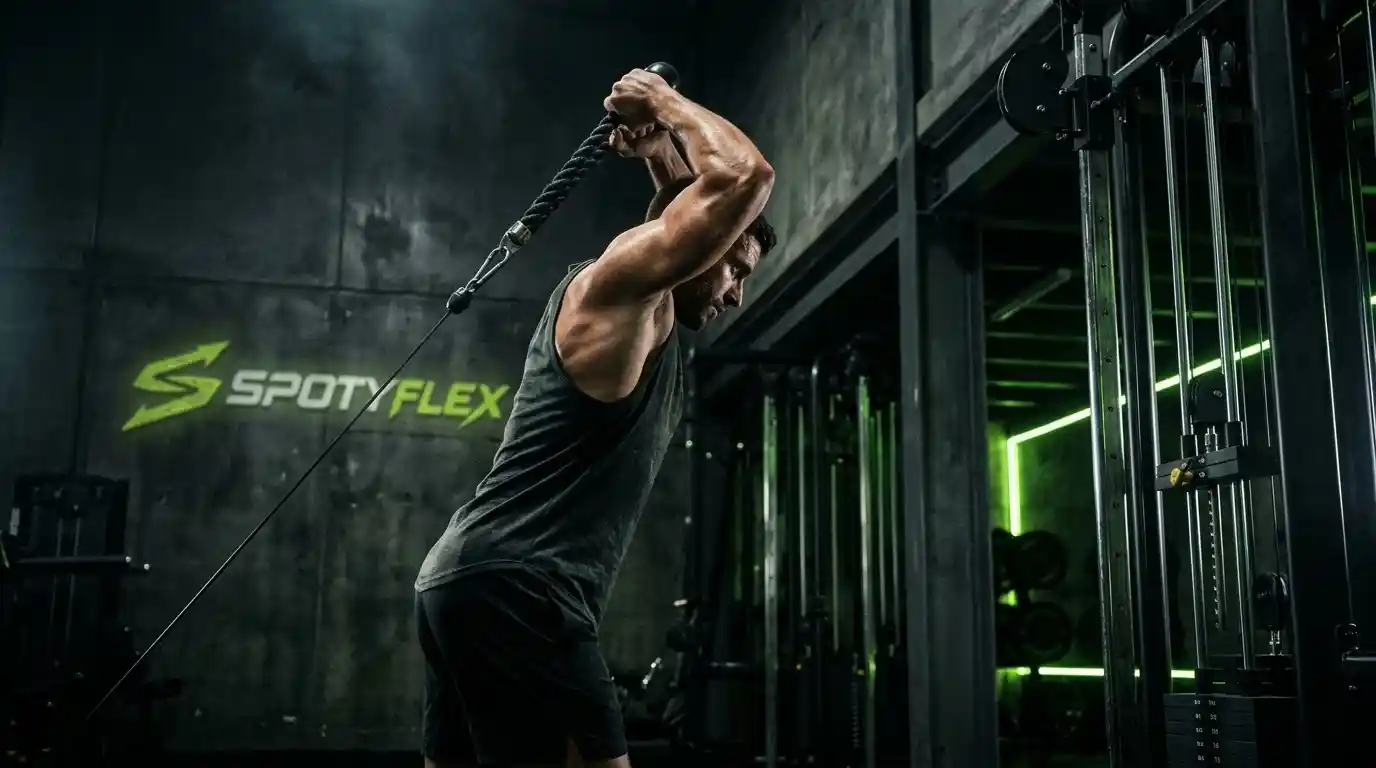
I start Session A with triceps while I'm fresh, then alternate with biceps so each muscle rests while the other one works. The first exercise is the one that changed my arms the most. The long head of the triceps runs along the back of your arm and also crosses the shoulder joint, so it gets stretched much more when your arm is overhead3. That's why the overhead extension comes first.
Session A
Triceps and biceps
Tap an exercise to check it off while you train.
| # | Exercise | Sets | Reps | Rest |
|---|---|---|---|---|
| 1 | Overhead cable rope extensionDumbbell swap: seated overhead dumbbell extension, both hands | 3 | 10 to 12 | 90 sec |
| 2 | Incline dumbbell curlDumbbell swap: seated dumbbell curl with your arms hanging straight down at the start | 3 | 10 to 12 | 90 sec |
| 3 | Cable rope pushdownDumbbell swap: resistance band pushdown, or close-grip push-up | 2 | 12 to 15 | 60 sec |
| 4 | Hammer curlDumbbells already, or use a cable rope | 2 | 10 to 15 | 60 sec |
Why these exercises?
Overhead cable extension. In a 12-week trial, 21 adults trained one arm with cable extensions overhead and the other with the arm by their side, twice a week, and MRI scans measured the muscle afterward. The whole triceps grew about 20 percent in the overhead arm and about 14 percent in the other, even though the overhead arm used lighter weights3. The authors also note that one earlier study found no clear difference3, and this was one exercise in a small group, so I treat it as a strong reason rather than a rule.
Incline dumbbell curl. Leaning back on the incline puts your arms behind your body, so the biceps start every rep stretched. In a 5-week trial of people who didn't lift, curls done near the straight-arm end of the range grew muscle thickness about 9 percent, against about 3 percent for curls done with the elbow already bent, with time under tension matched4. It's short and small, but it points the same way as the triceps study.
Pushdown and hammer curl. These are the lighter sets that come after. They add volume without needing heavy weights or much setup, which keeps the session quick.
Arms B: Biceps First
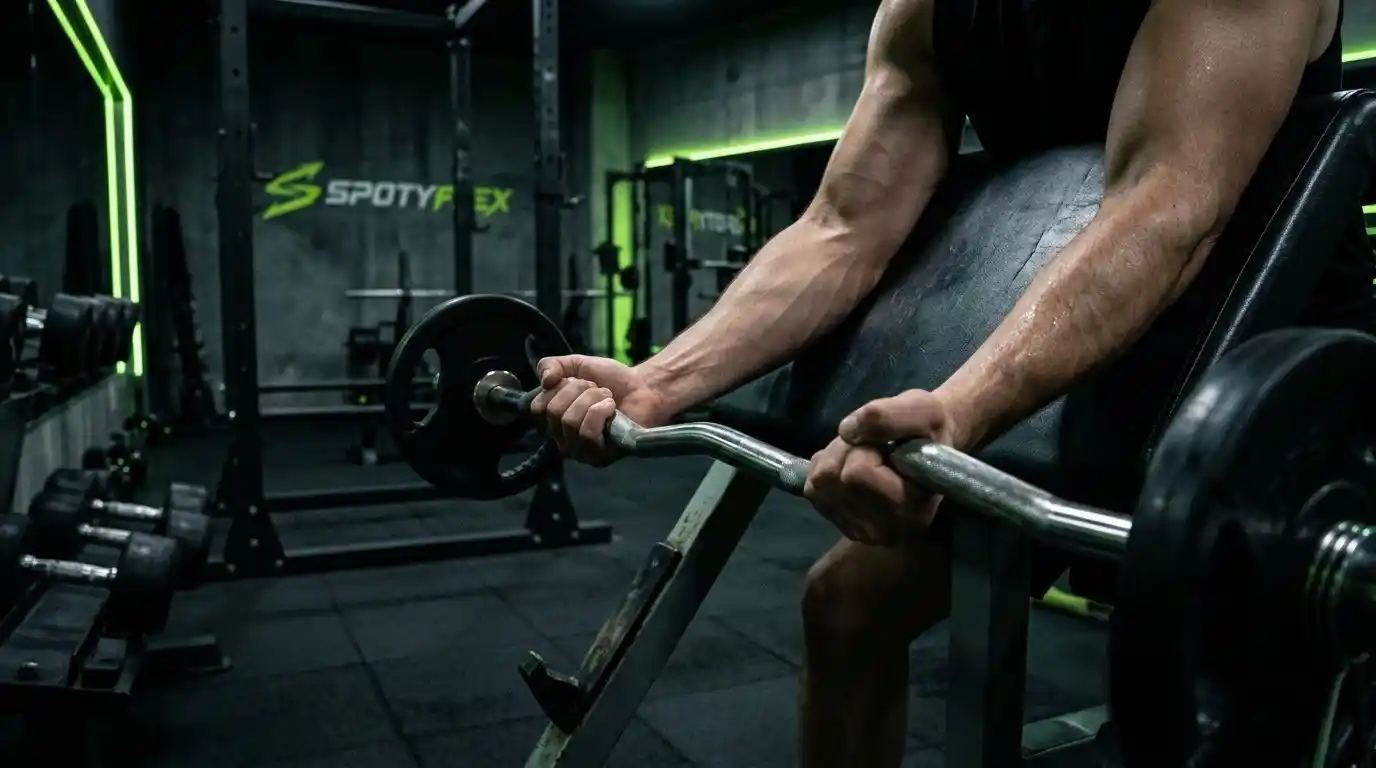
Session B flips the order so your biceps get the first fresh sets. The structure is the same but the exercises are different, which means each muscle gets a couple of angles across the week.
Session B
Biceps and triceps
Tap an exercise to check it off while you train.
| # | Exercise | Sets | Reps | Rest |
|---|---|---|---|---|
| 1 | Preacher curlDumbbell swap: one-arm dumbbell preacher curl, or a concentration curl with your upper arm braced on your thigh | 3 | 10 to 12 | 90 sec |
| 2 | Lying EZ-bar triceps extensionDumbbell swap: lying dumbbell extension with a neutral grip | 3 | 10 to 12 | 90 sec |
| 3 | Cable or EZ-bar curlDumbbell swap: standing dumbbell curl | 2 | 12 to 15 | 60 sec |
| 4 | Close-grip push-upEasier: hands on a bench. No equipment needed either way. | 2 | 8 to 15 | 60 sec |
Why these exercises?
Preacher curl. The pad holds your upper arm still, so you can't cheat with your shoulders, and the hardest part of the rep happens near the bottom where the biceps are stretched. It's the same stretched-position idea as the incline curl4, just from a different angle, so your arms see some variety.
Lying extension. Your elbows point up and the bar travels slightly behind your head, which keeps the triceps loaded at the bottom. If your shoulder feels pinched, use the dumbbell version with a neutral grip.
Close-grip push-up and the second curl. The push-up works the triceps with your own body weight, so it works anywhere. The last curl is a lighter finisher with a smooth tempo.
How I Make It Harder Over Time
Arms don't grow because you showed up. They grow because you ask for a little more than last time, whether that's one extra rep, one extra set or a slightly heavier weight. That's progressive overload, and it's the part I skipped for years. I grabbed the same dumbbells every week and wondered why nothing changed.
The rule I use
Pick a weight you can lift for the low end of the rep range with clean form. Each session, try to add a rep. Once you hit the top of the range on every set, go up by the smallest jump you can (about 1 to 2 kg, or one pin on the cable stack) and start again at the bottom of the range.
The volunteers in the triceps trial did a version of this. They raised the load by 5 percent of their max whenever the previous session was completed without failing a rep, and their working loads climbed by roughly 60 to 70 percent over the 12 weeks3.
Common Beginner Mistakes
Swinging the weight
I did this for ages. If your back or shoulders move on every rep, the weight is too heavy for your arms. Drop it until your upper arm stays still, and count about two seconds up and two seconds down, which is the tempo the volunteers in the curl study used4.
Cutting the stretch short
Half reps feel strong because the easy part of the range does the work. Across studies, full range of motion held a small edge over partial ranges5. In a review of 11 studies, full-range reps, or partial reps that stayed in the stretched part of the movement, grew the lower part of the biceps and brachialis more than partial reps in the shortened part6. So start every curl with your arm nearly straight, and take every extension through a full bend.
Skipping rows and presses because arms are their own thing
Your rows, pulldowns and presses already work your arms. In an 8-week trial in untrained men, adding direct arm exercises on top of compound lifts didn't improve the strength gains, though upper arm circumference rose a little more, about 5 percent against 4 percent7. Keep your main lifts and treat arm days as the extra that finishes the job.
Training arms every day
More isn't the prize. When weekly sets are equal, extra training days don't buy extra growth2, and arms that are sore all week give you shaky sets. Two planned sessions beat seven half-hearted ones.
How Long to Run This Program
Run it for 8 to 12 weeks and change nothing except the weights and reps. That's long enough to see where your numbers go, and it lines up with the 5 to 12 weeks used in the trials above34.
After that, check your tape measure and your log. If your lifts keep climbing, stay on the plan and add a set to the exercises you like most. If you're stuck, swap one exercise per muscle for a similar one (the dumbbell swaps in the tables are a good start) and keep the stretched-position idea. Frequency is flexible too, since with equal weekly sets it's your call2.
Questions I Get About This Plan
Can I do this at home with dumbbells?
Yes. Every exercise in the tables has a dumbbell or bodyweight swap. A resistance band covers the pushdown, and a sturdy chair or bed edge works as an incline or bench if you have no gym gear.
How long until I see results?
What if I miss a session?
Just do the next one on schedule and don't try to double up. With weekly sets equal, there's no strong evidence that the exact day layout matters2. One missed session won't undo anything.
Do I need to be sore the next day?
No. Soreness is a poor way to judge a session. Check whether you hit your reps and added a little over time.
Can I swap exercises?
Yes. Keep the set count the same and try to keep one stretched-position exercise for each muscle, like an overhead extension for triceps and an incline or preacher curl for biceps.
Do I still need rows and presses?
Yes. They work your arms too7, and they train your back and chest. Arm days are an addition, not a replacement.
What to Read Next
Arm days sit on top of a full routine. If you're still putting that part together, start here.
How to build your first gym routineSources
- Schoenfeld BJ, Ogborn D, Krieger JW. Dose-response relationship between weekly resistance training volume and increases in muscle mass: a systematic review and meta-analysis. Journal of Sports Sciences. 2017. doi.org/10.1080/02640414.2016.1210197
- Schoenfeld BJ, Grgic J, Krieger J. How many times per week should a muscle be trained to maximize muscle hypertrophy? A systematic review and meta-analysis of studies examining the effects of resistance training frequency. Journal of Sports Sciences. 2019. PubMed 30558493
- Maeo S, Wu Y, Huang M, Sakurai H, Kusagawa Y, Sugiyama T, Kanehisa H, Isaka T. Triceps brachii hypertrophy is substantially greater after elbow extension training performed in the overhead versus neutral arm position. European Journal of Sport Science. 2023. PubMed 35819335
- Sato S, Yoshida R, Kiyono R, Yahata K, Yasaka K, Nunes JP, Nosaka K, Nakamura M. Elbow joint angles in elbow flexor unilateral resistance exercise training determine its effects on muscle strength and thickness of trained and non-trained arms. Frontiers in Physiology. 2021. doi.org/10.3389/fphys.2021.734509
- Wolf M, Androulakis-Korakakis P, Fisher J, Schoenfeld B, Steele J. Partial vs full range of motion resistance training: a systematic review and meta-analysis. International Journal of Strength and Conditioning. 2023. doi.org/10.47206/ijsc.v3i1.182
- Kassiano W, Costa B, Nunes JP, Ribeiro AS, Schoenfeld BJ, Cyrino ES. Which ROMs lead to Rome? A systematic review of the effects of range of motion on muscle hypertrophy. Journal of Strength and Conditioning Research. 2023. PubMed 36662126
- Barbalho M, Coswig VS, Raiol R, Steele J, Fisher JP, Paoli A, Bianco A, Gentil P. Does the addition of single joint exercises to a resistance training program improve changes in performance and anthropometric measures in untrained men? European Journal of Translational Myology. 2018. doi.org/10.4081/ejtm.2018.7827