


This article contains affiliate links. If you purchase through them, we may earn a small commission at no extra cost to you.
You train. You eat your protein. You drink your overpriced pre-workout.
And yet… something's off.
You're tired all the time. Your lifts haven't moved in weeks. You look in the mirror and think — seriously, what is the point.
Here's the uncomfortable truth nobody wants to hear:
You're probably sleeping like garbage. And your body is absolutely not okay with that.
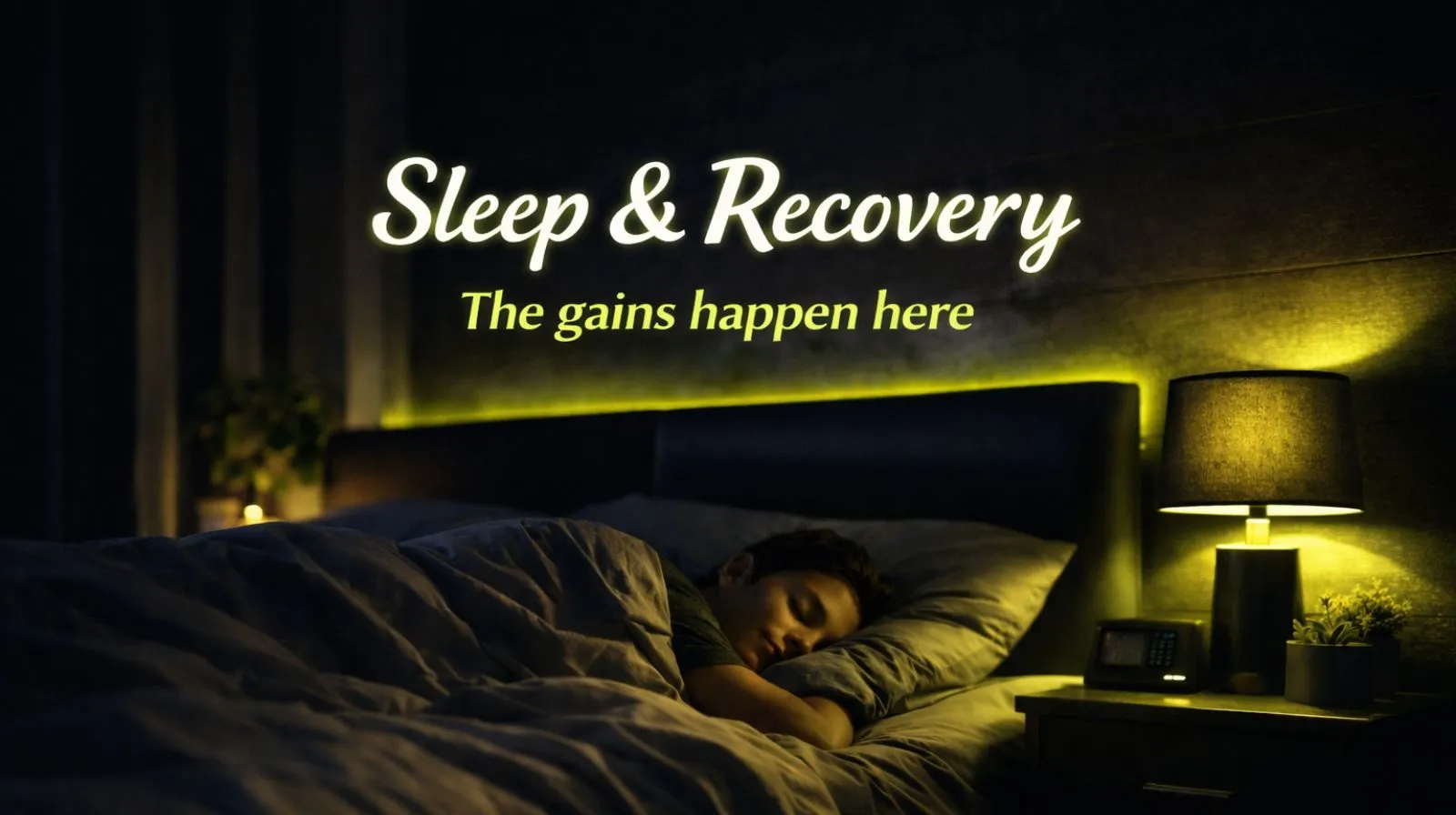
Sleep isn't the boring part of fitness. It's basically the whole thing. The gym is just where you create the damage. Sleep is where the actual magic happens.
Miss it consistently? All that damage just… stays. No repair. No growth. No gains. Just a tired, sore, confused version of yourself wondering why nothing's working.
Let's fix that.
Why sleep is the cheat code you've been ignoring
Let's talk about the fitness industry for a second.
It loves selling you things. Pre-workout. Post-workout. Intra-workout. (Yes, intra-workout is a real product category. We're at that point now.)
And look — some of that stuff has its place. But the single most powerful recovery tool available to you is completely free, requires zero effort, and you're supposed to do it every night anyway.
It's sleep. You just have to actually do it.
While you're knocked out, your body is basically running a full maintenance operation:
- Repairing the muscle fibers you tore up in the gym
- Releasing growth hormone (the good stuff)
- Resetting your nervous system so you don't feel like a zombie
- Balancing hormones so you don't spend tomorrow eating everything in sight
Skip that process consistently and no amount of protein shakes is saving you.

Imagine losing 30% of your strength overnight just because you stayed up watching one more episode. That's not a trade worth making.
What actually happens while you sleep
Sleep isn't just you lying there doing nothing (even if it looks that way). Your body cycles through four stages every ~90 minutes. Each one does a different job.
Stage 3 — deep sleep — is the one your muscles actually care about. This is when your pituitary gland goes to work and pumps out growth hormone. That's the stuff that patches up the damage you did squatting and benching and generally destroying yourself.
REM handles the mental side. Focus. Mood. Motivation. Ever wake up after a rough night and feel like the gym is literally the worst idea anyone has ever had? That's what happens when your REM gets cut short.
A full night gives you 4–6 complete cycles. Cut it short and you're literally skipping stages of recovery. You wouldn't leave the gym halfway through your workout. Don't do it with sleep either.

How much do you actually need?
More than you're getting. Probably.
For most adults: 7–9 hours. If you're training hard — lifting multiple days a week, doing cardio on top, playing sport — go toward the higher end. Your body has more repair work to do than someone who just walks to the fridge and back.
Now, some people swear they're fine on 5–6 hours. And here's the thing about that...
People who run on 6 hours and say they're fine have usually just adapted to feeling impaired. It's like being slightly drunk every day and calling it your baseline. You stop noticing because you forgot what normal feels like.
The science on this is pretty clear. You might feel okay. You're not performing okay. There's a difference.
Signs your body is screaming at you to recover
Your body is always communicating. Most people just have notifications turned off. Here's what under-recovery actually looks like:
You're always sore
Some soreness is normal. Soreness that sticks around for 4+ days after every session is your muscles waving a little white flag. They didn't get what they needed to recover.
Your lifts are going backwards
Hit a weight last week, can't hit it today? Before you blame your program, check your sleep. Strength declines fast when recovery is poor. It's one of the first things to go.
You're hungry like a wild animal
Sleep deprivation spikes ghrelin (your hunger hormone) and crushes leptin (your fullness hormone). So if you're eating a full meal and still thinking about your next snack — check how much you slept last night. Seriously.
You dread training
When you're well rested, the gym is something you want to do. When you're not, it feels like a punishment. If every session feels like a chore lately, it's probably not your motivation. It's your recovery.
You keep getting sick
Sleep is heavily tied to immune function. If you're catching every cold that comes near you, your body is trying to tell you something. Rest. Recover. Let it do its thing.

7 habits that actually work
No £200 sleep gadget required. This is the stuff that genuinely moves the needle.
Keep the same sleep schedule every day
Your body has an internal clock. When your bedtime jumps around — Monday 10pm, Friday 2am, Saturday "I don't even know" — that clock gets completely confused. Pick a wake time and stick to it even on weekends. It's annoying. It works.
Put the phone down an hour before bed
Blue light from your screen tells your brain it's midday. You're lying in bed in the dark scrolling Instagram and your brain genuinely thinks it's noon. Melatonin production drops. Sleep quality tanks. No amount of magnesium fixes this if you're doing doom-scrolling until midnight.
Magnesium Glycinate — the sleep supplement worth taking
If your sleep quality is consistently poor, magnesium glycinate is one of the few supplements with real evidence behind it. It activates your parasympathetic nervous system, helps regulate melatonin, and has been shown to increase deep sleep duration. Take 300–400mg about 30–60 minutes before bed.
→ Check Magnesium Glycinate on Amazon
Make your room cold and dark
Your core temperature needs to drop slightly to get into deep sleep. A cooler room (16–19°C / 60–67°F) makes that happen faster. Blackout curtains are cheap, easy to install, and genuinely one of the best sleep upgrades you can make. Streetlights are not your friend.
Watch your caffeine timing
Caffeine has a half-life of around 5–6 hours. The 3pm coffee? Half of it is still active at 9pm. If you train in the evening and take pre-workout at 7pm, don't be surprised when you're lying awake at midnight with your heart going brrr.
Don't train too close to bedtime
Intense training spikes cortisol and raises your core temperature — both of which make falling asleep harder. Aim to finish your workout at least 2–3 hours before bed. Light stretching or mobility work in the evening is totally fine and actually helps wind you down.
Don't go to bed starving
A big heavy meal right before bed disrupts sleep. But going to bed hungry can spike cortisol and wake you up in the middle of the night. A small protein-rich snack — Greek yogurt, cottage cheese, handful of nuts — about an hour before bed hits the sweet spot for most people.
Actually manage your stress
This one sounds soft until you realise that chronically high cortisol is one of the biggest wreckers of sleep quality. A 5-minute breathing exercise, a short walk, writing down what's on your mind before bed — these aren't "wellness fluff." They actually lower your nervous system activation so your body can switch into recovery mode.

Are naps cheating? (No. They're not.)
Naps have an unfair reputation as something lazy people do. Elite athletes nap. High performers nap. Your cat naps constantly and has incredible muscle tone relative to body weight. Just saying.
Done right, a nap is genuinely useful — especially after a bad night or if you're training twice a day.
The sweet spot: 20 minutes. Long enough to feel refreshed. Short enough to avoid falling into deep sleep, which leaves you groggy and confused about what year it is. Set an alarm. Lie down. Don't stress about whether you actually fall asleep — just resting with your eyes closed is beneficial.
One rule: keep it before 3pm. Napping too late pushes back your sleep onset at night and undoes all the discipline you just built with your consistent schedule.

- Leproult R, Van Cauter E. Effect of 1 week of sleep restriction on testosterone levels in young healthy men. PubMed — JAMA, 2011
- Dattilo M, et al. Sleep and muscle recovery: endocrinological and molecular basis for a new and promising hypothesis. PubMed — Medical Hypotheses, 2011
- Nedeltcheva AV, et al. Insufficient sleep undermines dietary efforts to reduce adiposity. PubMed — Annals of Internal Medicine, 2010
- Spiegel K, Tasali E, Penev P, Van Cauter E. Brief communication: sleep curtailment in healthy young men is associated with decreased leptin levels, elevated ghrelin levels, and increased hunger and appetite. PubMed — Annals of Internal Medicine, 2004
- Van Dongen HP, et al. The cumulative cost of additional wakefulness: dose-response effects on neurobehavioral functions and sleep physiology. PubMed — Sleep, 2003
- Besedovsky L, Lange T, Born J. Sleep and immune function. PubMed — Pflügers Archiv, 2012
Younes Ouba
Founder of SpotyFlex, Full-Stack Developer & lifelong fitness enthusiast. I build the platform and the content. The goal is always the same: real fitness knowledge, zero BS.

/1.webp)
