



You're training hard, eating enough protein, and tracking your calories. But you're sleeping five or six hours a night and wondering why your progress has stalled. Here's the part most fitness content skips: sleep isn't passive recovery — it's when the majority of muscle repair and growth actually happens. Cut it short and you're undermining everything you do in the gym.
This guide covers the science of sleep and muscle growth, the specific hormonal mechanisms involved, and the practical changes that will actually make a difference to your results.
- →~70% of growth hormone is released during deep sleep — shorting sleep limits GH output directly
- →Sleeping under 6 hours raises cortisol and lowers testosterone — the exact opposite of what builds muscle
- →Sleep-deprived people lose significantly more lean mass during a calorie deficit
- →Most people need 7–9 hours; hard-training athletes often need the upper end
- →Sleep quality matters as much as quantity — 8 fragmented hours isn't the same as 7 solid ones
- →Consistent sleep and wake times are the single highest-impact fix most people can make
Why Sleep Matters More Than Most Training Variables
Think about the training variables you obsess over: rep ranges, progressive overload, training frequency, exercise selection. All of those matter. But every single one of them depends on recovery to produce a result — and sleep is where the majority of that recovery happens.
Muscle protein synthesis (MPS) — the process of building new muscle tissue — is elevated for 24–48 hours after a hard training session. During that window, your body needs raw materials (protein) and the right hormonal environment to actually do the work. Sleep creates that environment. Without adequate sleep, you're leaving the anabolic window open with no one home to take advantage of it.
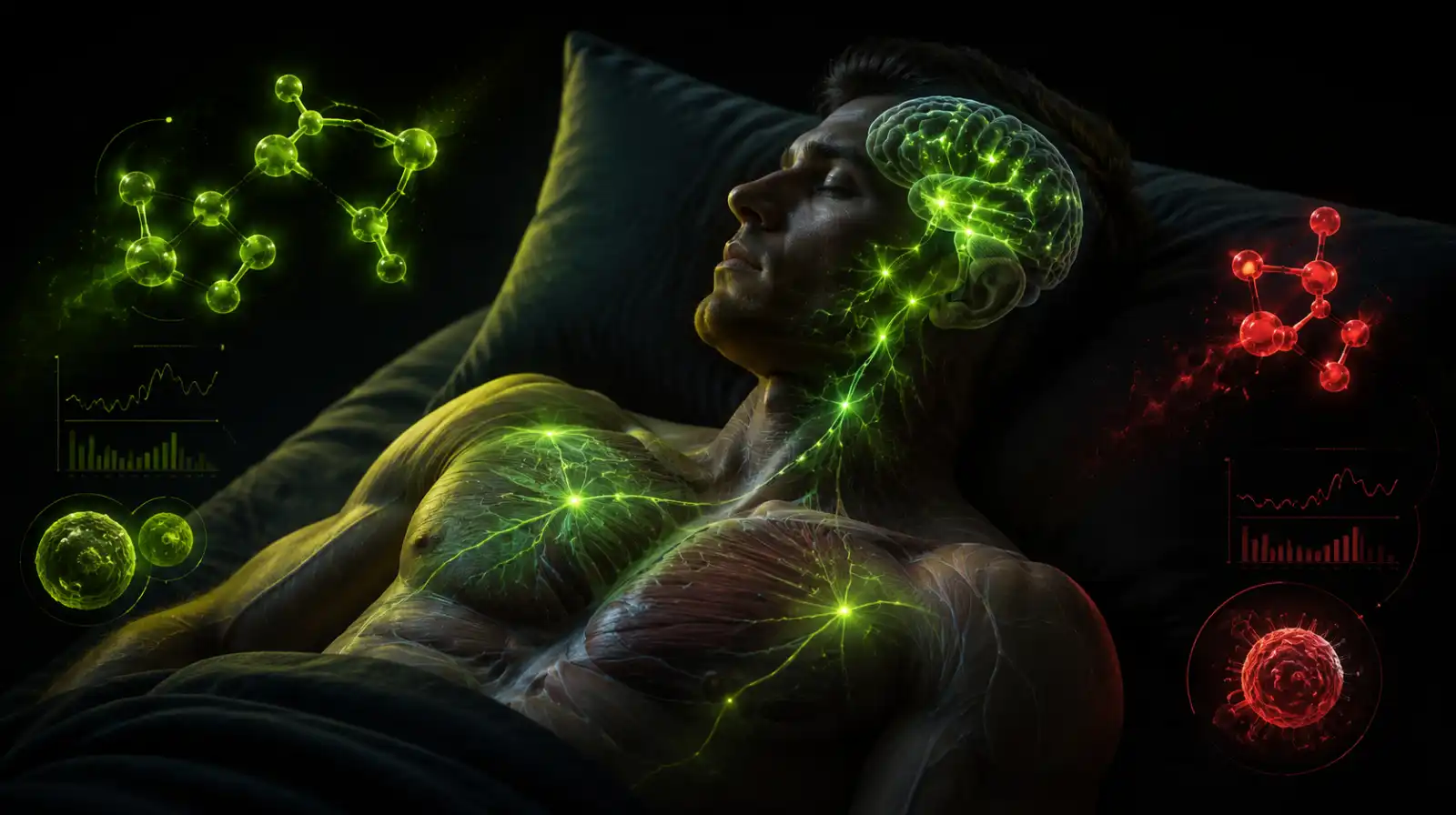
The Hormonal Cascade That Builds Muscle at Night
Sleep isn't a single state. It cycles through multiple stages — light sleep, deep (slow-wave) sleep, and REM sleep — and each stage plays a different role in recovery. The most important for muscle growth is deep sleep.
Growth Hormone — The Nighttime Anabolic Driver
The pituitary gland releases approximately 70% of your daily growth hormone output during the first few hours of deep sleep. Growth hormone drives muscle protein synthesis, promotes fat oxidation, and supports tissue repair. It's one of the most potent anabolic signals in the body — and the majority of it is tied directly to sleep quality and duration.
When you cut sleep short or your sleep is fragmented, you reduce time in deep sleep, which directly reduces GH output. You can't inject more training volume to compensate for this. It's a hormonal reality.
Testosterone — How Sleep Debt Tanks Your T-Levels
Most testosterone secretion happens during sleep, peaking in the early morning hours. Research from the Journal of the American Medical Association showed that sleeping just 5 hours per night for one week reduced testosterone levels in healthy young men by 10–15%. That's equivalent to ageing 10–15 years in hormonal profile — from one week of poor sleep.
Low testosterone means slower muscle protein synthesis, reduced strength gains, worse recovery, and lower motivation to train. It's not a small effect.
Cortisol — The Catabolic Pressure That Rises With Sleep Debt
Cortisol is a catabolic hormone — it breaks down tissue, including muscle. While cortisol serves important functions, chronically elevated cortisol is the enemy of muscle growth. Sleep deprivation causes cortisol to spike. Combined with suppressed testosterone and GH, the hormonal environment becomes almost directly opposed to building muscle.
| Hormone | Role in Muscle Growth | Effect of Sleep Deprivation |
|---|---|---|
| Growth Hormone | Drives MPS, fat oxidation, tissue repair | ↓ Significantly reduced output |
| Testosterone | Anabolic signalling, strength, recovery | ↓ 10–15% after 1 week of 5h sleep |
| Cortisol | Catabolic — breaks down muscle tissue | ↑ Chronically elevated |
| IGF-1 | Works alongside GH for MPS | ↓ Reduced when GH is suppressed |
| Leptin / Ghrelin | Hunger regulation, metabolic signalling | ⚡ Disrupted — increased hunger, fat gain |
What Sleep Deprivation Actually Does to Your Gains
Beyond the hormonal picture, the practical consequences of chronic under-sleeping are well-documented and directly relevant to training outcomes:
How Much Sleep Do You Actually Need?
The research consistently points to 7–9 hours for most adults as the range that supports full hormonal recovery, cognitive function, and physical repair. The sweet spot for most recreational athletes appears to be around 7.5–8.5 hours.
Factors that push you toward the upper end of that range:
- ▸Training volume is high (4–6 sessions per week, heavy compound work)
- ▸You're in a calorie deficit — cutting increases tissue breakdown, so recovery demand rises
- ▸High stress outside the gym — cortisol from life stress competes with your recovery resources
- ▸You're a beginner — early training adaptations require more neural and muscular recovery
- ▸You're older — GH release naturally decreases with age, so optimising sleep matters even more
Sleep Quality vs Sleep Quantity
Eight hours in bed is not the same as eight hours of restorative sleep. Sleep quality — how much time you spend in deep sleep and REM versus light, fragmented sleep — determines how much recovery actually happens.
- ✗Alcohol — Reduces REM sleep even in moderate amounts
- ✗Caffeine after 2pm — 5–6h half-life means evening coffee still matters at 9pm
- ✗Blue light / screens — Suppresses melatonin, delays sleep onset
- ✗Warm room — Core temp must drop to initiate sleep; above 19°C impairs it
- ✗Irregular schedule — Variable sleep/wake times disrupt circadian rhythm
- ✓Consistent schedule — Same bedtime + wake time, 7 days a week
- ✓Cool dark room — 17–19°C, blackout curtains or eye mask
- ✓No caffeine after 1–2pm — Adjust based on sensitivity
- ✓Morning/afternoon training — Heavy exercise within 1–2h of bed raises core temp and SNS activation
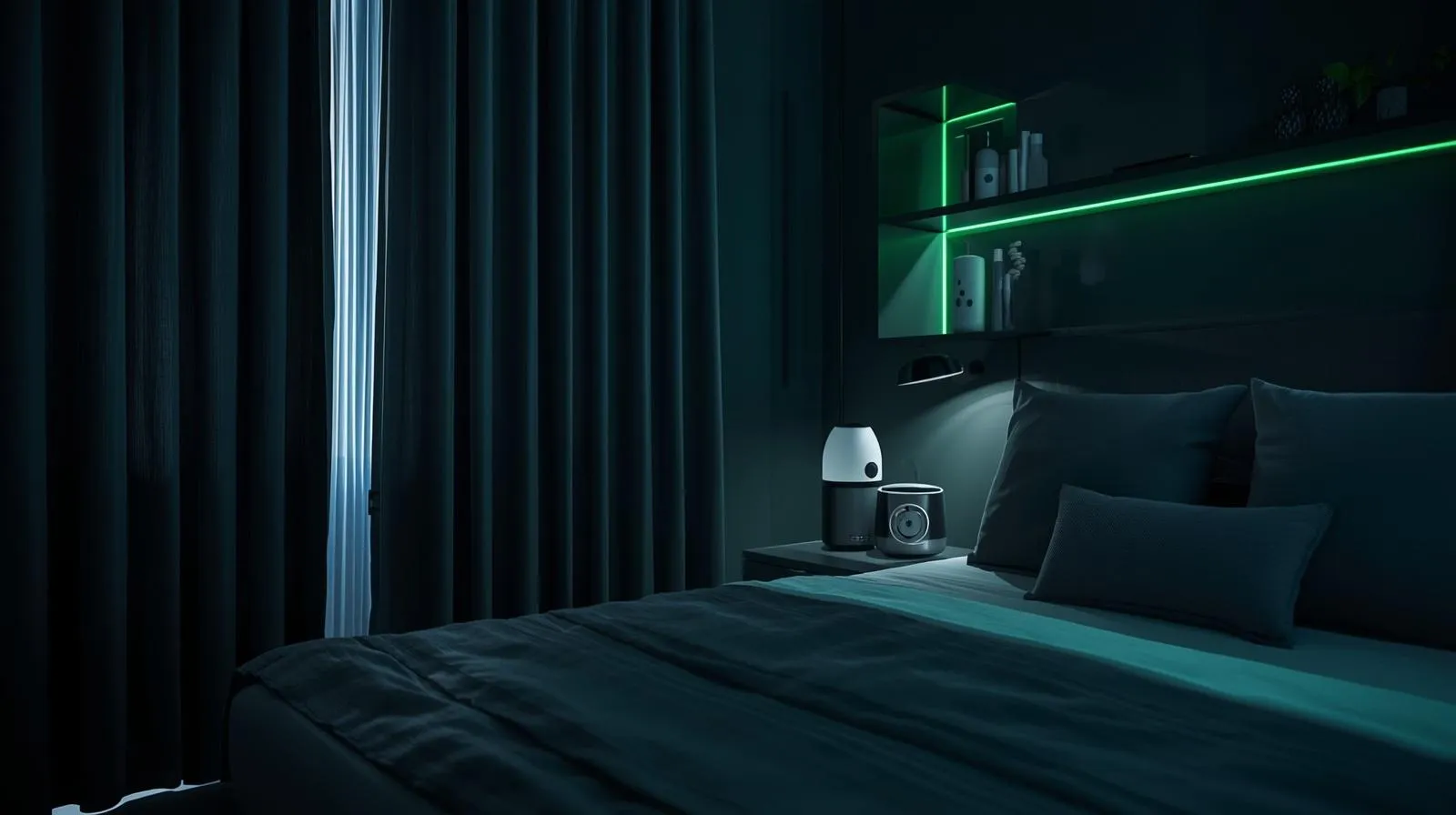
How to Improve Your Sleep for Better Recovery
These are the changes with the highest evidence base and the most practical impact. No complex protocols — just the stuff that actually works:

Your wake time anchors your circadian rhythm. Set it and don't move it, even on weekends. After 2–3 weeks, your body will naturally begin feeling sleepy at the right time to get your full sleep need before that alarm. This single change improves sleep quality significantly for most people.
Your nervous system needs a transition period. Dim lights, stop work, stop screens, and do something low-stimulation — reading, stretching, light conversation. The point is to shift out of sympathetic (alert) mode before you try to sleep.
Blackout curtains or an eye mask. A fan or white noise for sound masking. Temperature between 17–19°C. These are passive changes that improve every night automatically once you set them up.
Harder for habitual caffeine users but makes a measurable difference in deep sleep duration. If you need afternoon energy, try a 10–20 minute nap (set a timer) before 3pm instead.
Even one drink disrupts REM sleep in the second half of the night. If you drink socially, earlier is better. Alcohol as a sleep aid is counterproductive — it helps you fall asleep faster but produces fragmented, low-quality sleep overall.
The Bottom Line
Sleep is not a passive background condition — it's an active anabolic state. The hormones that build muscle, the neural processes that consolidate technique, the tissue repair that makes you stronger — all of this happens primarily during sleep. Cutting that window short is functionally equivalent to skipping recovery entirely.
If you're training consistently, eating enough protein, and still not progressing the way you expect — audit your sleep before you change your programming, add supplements, or increase training volume. Sleeping 7.5–9 hours in a consistent, high-quality window is one of the most powerful performance-enhancing interventions available, and it's free.
This article is based on peer-reviewed research in sleep science and sports physiology.
- Nedeltcheva AV, et al. (2010). Insufficient sleep undermines dietary efforts to reduce adiposity. Annals of Internal Medicine, 153(7), 435–441. pubmed →
- Leproult R, Van Cauter E. (2011). Effect of 1 week of sleep restriction on testosterone levels in young healthy men. JAMA, 305(21), 2173–2174. pubmed →
- Van Cauter E, Plat L. (1996). Physiology of growth hormone secretion during sleep. Journal of Pediatrics, 128(5 Pt 2), S32–S37. pubmed →
- Milewski MD, et al. (2014). Chronic lack of sleep is associated with increased sports injuries in adolescent athletes. Journal of Pediatric Orthopaedics, 34(2), 129–133. pubmed →
- Watson AM. (2017). Sleep and athletic performance. Current Sports Medicine Reports, 16(6), 413–418. pubmed →
Younes is the founder and content creator behind SpotyFlex — a fitness blog built on the principle that real training knowledge shouldn't be buried under bro-science and filler. He covers nutrition, body composition, and strength training with a focus on what the research actually supports.

/1.webp)
