



Most beginners walk into the gym, pick exercises they vaguely recognise, do a random number of sets, and repeat that indefinitely. It feels like training. It isn't. Real progress requires a structured routine — one built around proven principles, not YouTube trends or whatever the biggest person in the gym happens to be doing.
This guide gives you a complete, no-BS framework for building your first gym routine. Not a routine you'll abandon in three weeks, but one designed around how your body actually responds to training as a beginner — which, conveniently, is the most responsive it will ever be. We're talking faster strength gains, better neural adaptation, and muscle growth happening simultaneously — a window that experienced lifters would pay to have back.
- Train 3 days per week full-body — more frequency per muscle beats more volume crammed into one session
- Build your routine around 5 compound movements: squat, hinge, push, pull, overhead press
- 3 sets of 5–8 reps per exercise is plenty when you're new — don't overthink volume
- Add weight or reps every single session — progressive overload is the only real driver of long-term progress
- Consistency over 12 weeks beats any "optimal" program you can't stick to
- Technique first, weight second — every time, no exceptions
The Beginner Advantage You Need to Exploit
Here's something most fitness content doesn't tell you clearly: you will never make faster progress than you will in your first 6–12 months of consistent training. This isn't motivation talk — it's a physiological reality called "newbie gains," and understanding it should completely change how you approach your first year in the gym.
As a beginner, your body responds to training stimulus so effectively that you can gain strength and muscle simultaneously, even in a slight calorie deficit. This is something intermediate and advanced athletes simply cannot do reliably. The mechanism behind it is twofold: neural adaptations happen first — your nervous system learns to recruit existing muscle fibres more efficiently, producing rapid strength increases in the first 4–6 weeks before significant muscle growth even occurs. Then hypertrophy takes over, building actual new muscle tissue on top of those neural gains.
Research published in the Journal of Strength and Conditioning Research shows that untrained individuals can increase their 1RM by 25–40% in the first 6–8 weeks of training — numbers that experienced lifters chase for years. The window is uniquely powerful, and it only happens once.
The downside? Most beginners waste this window by training inconsistently, hopping between programs every few weeks, or following overly complex routines designed for intermediate and advanced athletes. A simple, well-structured beginner routine will outperform a complicated advanced program every time for someone who's new to lifting. Complexity is not a virtue here — precision and consistency are.
The Four Principles Every Beginner Routine Must Follow
Before picking exercises or scheduling sessions, understand what your routine needs to do. These four principles are non-negotiable — they're the framework everything else sits inside of. If a program violates any of them, it's not a good beginner program, regardless of how polished it looks.
Training Frequency — How Often Should You Lift?
For beginners, the research strongly supports training each muscle group 2–3 times per week. This is more frequent than most gym-goers expect — and it's one of the most important structural decisions you'll make.
The mechanism is straightforward: muscle protein synthesis (the process that builds new muscle tissue) is elevated for roughly 24–48 hours after a training session, then returns to baseline. Training a muscle once per week means you're maximising that growth window for 1–2 days out of 7. Training it three times spreads that stimulus across the full week, producing more total growth signal from the same or even less total volume per session.
A 2016 meta-analysis by Schoenfeld, Ogborn, and Krieger — one of the most cited papers in resistance training research — found that training muscle groups twice per week produced significantly greater hypertrophy than once per week, when total volume was equated. More frequency, same work, better results.
| Training structure | Sessions/week | Best for beginners? | Notes |
|---|---|---|---|
| Full-body 3×/week | 3 | ✅ Ideal | Every muscle trained every session; high frequency with manageable per-session volume |
| Upper/Lower split | 4 | ✅ Good option | Solid stepping stone toward PPL; still high frequency |
| Push/Pull/Legs | 3–6 | ⚠️ Intermediate | At 3 days, each muscle only hits once per week; better at 6-day frequency |
| Bro split (1 muscle/day) | 5–6 | ❌ Suboptimal | Low weekly frequency per muscle; long gaps between stimuli; not evidence-backed for beginners |
The recommendation: start with 3 full-body sessions per week. Monday, Wednesday, Friday is the classic structure for good reason. You get training stimulus three times per week and 48+ hours of recovery between each session — enough time for adaptation, not enough time to lose momentum.

The Compound Lifts That Do the Heavy Lifting
Compound movements — exercises that recruit multiple joints and muscle groups simultaneously — are the foundation of any effective beginner routine. They produce the most systemic stimulus per set, allow the heaviest progressive loading over time, and build functional strength that carries over to everything else you'll ever do in the gym. As a beginner, they should make up 80–90% of your total training volume.
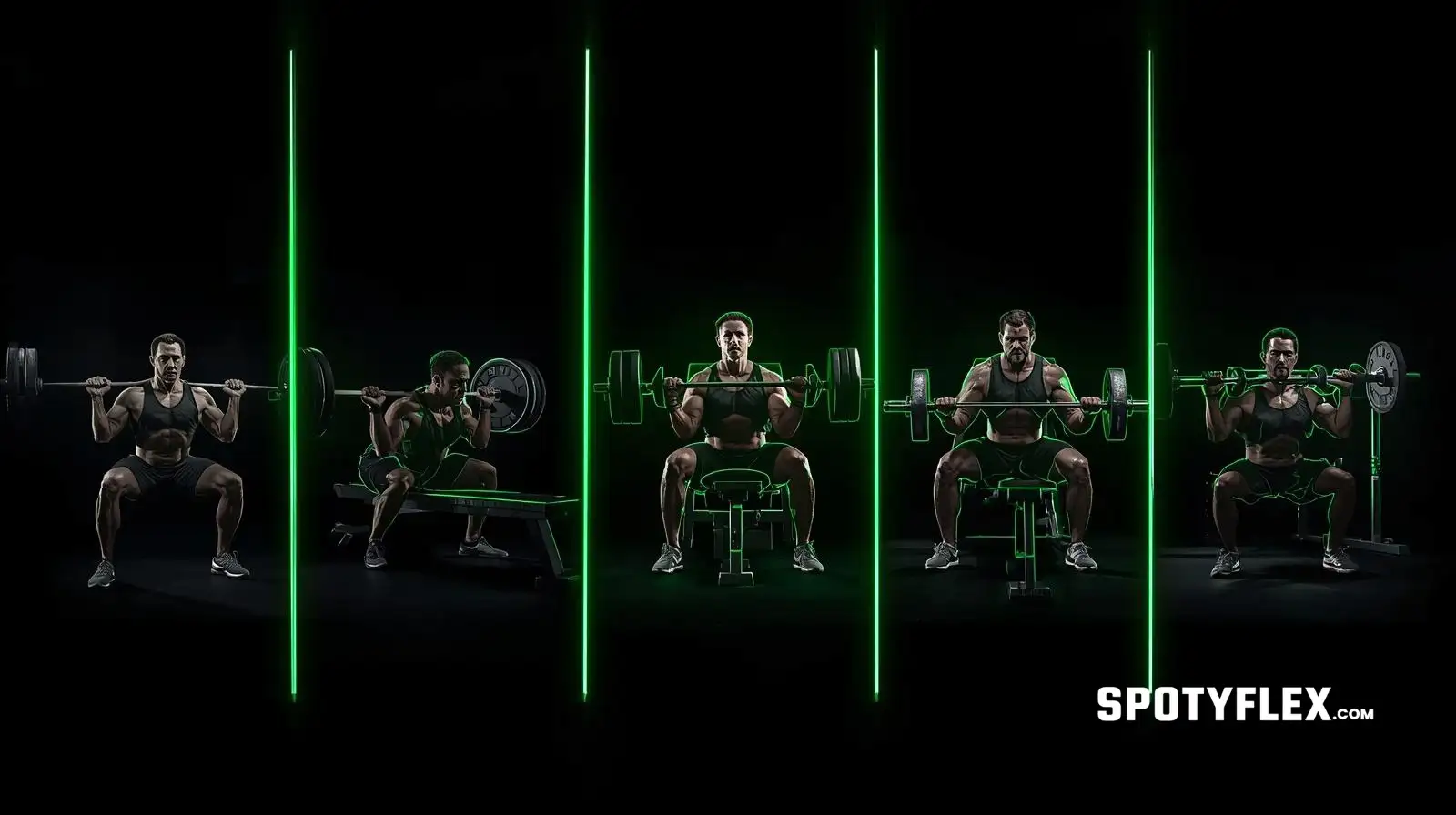
Your routine should be built around these five movement patterns. Every one of them is supported by decades of strength and hypertrophy research as the most efficient way to build a strong, capable body from zero:
Building Your Actual Routine
Here's a complete, ready-to-use beginner full-body routine. Three sessions per week, built around the five compound movement patterns above. This is not complicated — that's intentional. Complexity does not produce results at this stage. Execution does.
Session A runs Monday and Friday (slight variation keeps training stimulus high without repetition). Session B runs Wednesday. The alternating structure ensures every muscle gets hit at least twice per week with enough variation to prevent staleness.
| Exercise | Sets | Reps | Rest | Focus |
|---|---|---|---|---|
| Session A — Monday & Friday | ||||
| Goblet squat → Back squat | 3 | 5–8 | 2–3 min | Quad, glute, core |
| Dumbbell bench press | 3 | 6–10 | 90 sec | Chest, front delt, tri |
| Dumbbell row (each side) | 3 | 8–10 | 90 sec | Lats, mid-back, bi |
| Plank hold | 3 | 20–45 sec | 60 sec | Core stability |
| Dumbbell bicep curl (acc.) | 2 | 10–12 | 60 sec | Biceps |
| Session B — Wednesday | ||||
| Romanian deadlift | 3 | 6–8 | 2–3 min | Hamstrings, glutes, back |
| Dumbbell overhead press | 3 | 8–10 | 90 sec | Shoulders, tri, upper chest |
| Lat pulldown or assisted pull-up | 3 | 8–10 | 90 sec | Lats, rhomboids, bi |
| Glute bridge | 3 | 12–15 | 60 sec | Glutes, hamstrings |
| Tricep pushdown (acc.) | 2 | 12–15 | 60 sec | Triceps |
Total time per session: approximately 45–60 minutes including a 5–10 minute warm-up. That's enough. Do not add more exercises just to feel like you did more. Volume is not the same as effectiveness. More sets with insufficient recovery between them is a step backwards, not forwards.
Progressive Overload — The Engine of All Progress
Progressive overload means making your training progressively harder over time. Without it, you maintain your current fitness level — permanently. Your body adapts to whatever you repeatedly ask it to do, then stops adapting once it's no longer challenged. That's the fundamental biology. Progressive overload is the mechanism you use to keep challenging it.
For beginners, progressive overload takes its simplest and most effective form: add weight to the bar every session you can. When you can complete all sets and reps with good form and the last rep of the last set feels like you have 2–3 more in reserve, add weight next session. That's it. No periodisation schemes, no wave loading — just consistent, small increases.
Lower body lifts: Add 5 kg when you complete all reps cleanly across all sets
If you fail to progress 3 sessions in a row: Drop to 90% of working weight and rebuild — or audit your sleep, protein, and recovery first
Log every session: Exercise, weight, sets completed, reps per set. If it's not written down, it didn't happen and you're guessing.
As a beginner, you can often add weight every single session for the first 8–12 weeks. This is called linear progression — and it is the most powerful training phase you will ever experience. Don't squander it by chasing complexity. The most sophisticated thing you can do right now is load the bar, add 2.5 kg, and repeat.

Common Beginner Mistakes That Stall Progress
The following mistakes are responsible for the vast majority of stalled progress, wasted newbie gains, and early burnout. Every one of them is avoidable if you know what to look for.
The Bottom Line
Your first gym routine doesn't need to be complex — it needs to be executed consistently over time. Train 3 days per week, build every session around 5 compound movements, add weight when your form allows it, eat enough protein, and sleep enough to actually recover. Do that for 12 weeks without changing the program and you will be a categorically different athlete than the one who walked in on day one.
Simplicity is not a limitation at this stage. For a beginner, simplicity is the entire strategy. You have a narrow window of accelerated adaptation that intermediate and advanced athletes would trade a lot to have back. The way to maximise it is to execute the fundamentals repeatedly, deliberately, and with increasing load — not to find a more complicated program.
The gym is a long game. The people who win it aren't the ones who found the most optimal program in month one — they're the ones who were still showing up in year three. Start with something simple, learn the movements well, and trust the process.
- 3 full-body sessions per week — Mon / Wed / Fri
- Log every session: exercise, weight, sets, reps
- Add weight when all reps are completed with clean form
- Hit 1.6–2.2g protein per kg bodyweight daily
- Sleep 7.5–9 hours per night — prioritise this
- Do not change the program for at least 8 weeks
- Warm up before every session — no exceptions

-
1Schoenfeld BJ, Ogborn D, Krieger JW. (2016). Effects of resistance training frequency on measures of muscle hypertrophy: a systematic review and meta-analysis. Sports Medicine, 46(11), 1689–1697. — The landmark meta-analysis establishing that 2× weekly frequency outperforms 1× for hypertrophy when volume is equated.PubMed 27102172
-
2Kraemer WJ, Ratamess NA. (2004). Fundamentals of resistance training: progression and exercise prescription. Medicine & Science in Sports & Exercise, 36(4), 674–688. — Foundational review covering progressive overload mechanics, exercise selection, and beginner training prescription.PubMed 15064596
-
3Ralston GW, et al. (2017). The effect of weekly set volume on strength gain: a meta-analysis. Sports Medicine, 47(12), 2585–2601. — Quantifies the dose-response relationship between weekly set volume and strength outcomes, supporting conservative volume recommendations for beginners.PubMed 28755103
-
4Morton RW, et al. (2018). A systematic review, meta-analysis and meta-regression of the effect of protein supplementation on resistance training-induced gains in muscle mass and strength. British Journal of Sports Medicine, 52(6), 376–384. — Establishes the 1.62g/kg/day upper threshold for protein intake in maximising muscle protein synthesis from resistance training.PubMed 28698222
-
5Aaberg E. (2007). Resistance Training Instruction. Human Kinetics. — Comprehensive reference for movement mechanics, exercise selection rationale, and compound lift technique progressions for beginners.Human Kinetics
-
6Van Cauter E, Leproult R, Plat L. (2000). Age-related changes in slow wave sleep and REM sleep and relationship with growth hormone and cortisol levels in healthy men. JAMA, 284(7), 861–868. — Documents the relationship between slow-wave sleep duration and growth hormone secretion, supporting sleep prioritisation in recovery protocols.PubMed 10938176
Younes is the founder and content creator behind SpotyFlex — a fitness blog built on the principle that real training knowledge shouldn't be buried under bro-science and filler. He covers nutrition, body composition, and strength training with a focus on what the research actually supports.