



Most people who start going to the gym don't actually have a workout routine. They have a vague idea. Show up, do some stuff, go home. Maybe hit chest on Monday because everyone does. Maybe copy what the big guy in the corner is doing. Maybe follow some random YouTube video and quit after two weeks because it never felt like it was going anywhere.
That's not a routine. That's wandering.
A real workout routine isn't just a list of exercises. It's a system — built around your specific goal, your schedule, your current fitness level, and the principles that actually drive progress. When you have that system, every session has a purpose. You stop guessing. You start progressing.
This guide is going to walk you through exactly how to build one from scratch. Not a generic template. The actual logic — so you can build something that fits your life and keeps working.
Step 1: Define Your Goal
This sounds obvious. It never is. Most people say "I want to get fit" — which is the equivalent of saying "I want to go somewhere" without specifying where. Not useful.
Your goal determines every single decision you make in your program: how many days you train, what kind of exercises you prioritize, how you eat around it, what supplements make sense. Get this wrong and you'll build a routine optimized for the wrong thing.
There are three primary training goals:
Build Muscle (Hypertrophy)
You want to increase muscle size. Priority: training volume (sets × reps), progressive overload, sufficient protein intake. Rep ranges typically 6–15. Rest periods 60–120 seconds.
Build Strength
You want to lift heavier. Priority: compound movements, lower reps, heavier load. Rep ranges typically 1–6. Rest periods 2–5 minutes. Powerlifting-style programming.
Lose Fat (and stay active)
You want to drop body fat while preserving muscle. Priority: caloric deficit, resistance training to protect muscle, cardio as a tool. Rep ranges 8–15. Often combined with nutrition strategy.
Most people reading this want a combination — lose some fat AND build some muscle. That's body recomposition. It's possible, especially for beginners. Choose the primary goal and let the program lean in that direction.

Step 2: Choose Your Training Frequency
How many days per week can you realistically train? Not how many days you want to train. How many you will actually show up for, consistently, for the next 3 months.
Consistency beats perfection every time. A 3-day program you actually do beats a 6-day program you half-follow.
| Days/Week | Best For | Notes |
|---|---|---|
| 2 days | Complete beginners, busy schedules | Better than nothing. Full body each session. |
| 3 days | Beginners to intermediate | Sweet spot. Full body 3x or upper/lower split. |
| 4 days | Intermediate lifters | Upper/lower or push/pull. Good volume balance. |
| 5 days | Experienced trainees | PPL + 2 days. Requires solid recovery habits. |
| 6 days | Advanced / dedicated | PPL x2. High volume. Most people don't need this. |
The honest recommendation: Start with 3 days. No matter your experience. If you're already training 5 days consistently, stay at 5. But if you're starting from scratch, 3 days gives you enough stimulus while leaving room for your body to actually recover and grow.
Step 3: Pick Your Training Split
A training split defines which muscle groups you train on which days. This is where most beginners overthink it — spending hours debating splits instead of actually training.
Here's the reality: for beginners, the split matters less than showing up consistently and pushing yourself. But if you want to make the right call from the start, here are the main options:
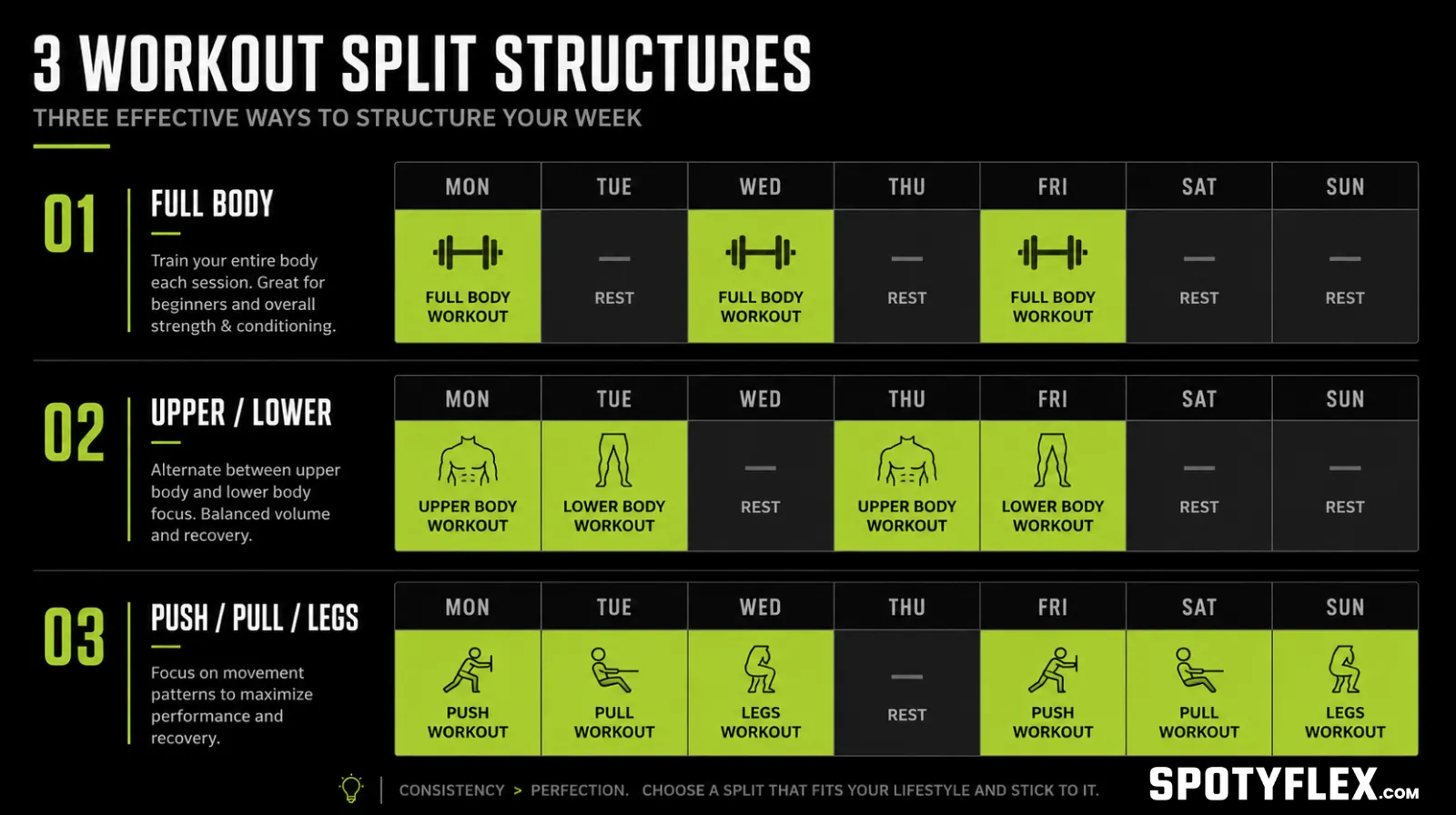
Full Body (3x/week) — Best for Beginners
Train every major muscle group each session. Monday, Wednesday, Friday. Each session hits chest, back, legs, shoulders, arms. Higher frequency per muscle group = faster neurological adaptation = faster strength gains early on. This is the most scientifically supported approach for beginners.
Upper / Lower (4x/week) — Best for Intermediate
Split the body into upper body days and lower body days. 2 upper + 2 lower per week. Good balance between frequency and volume. Once full body starts feeling limiting, this is the natural next step.
Push / Pull / Legs (3–6x/week) — Intermediate to Advanced
Push days: chest, shoulders, triceps. Pull days: back, biceps. Leg days: quads, hamstrings, glutes, calves. Run it 3x a week for a full body cycle, or 6x for PPL twice. High volume per session, moderate frequency per muscle. Popular for a reason — it works.
Bro Split (1 muscle/day) — Not recommended for most
Chest Monday, back Tuesday, shoulders Wednesday... Each muscle trained once a week. Low frequency, high session volume. Research shows training a muscle 2x per week produces better gains than 1x. The bro split survives mostly by tradition, not science.
Beginner? Full body 3x. Can't decide between splits? Upper/Lower 4x. Already have training history? Push/Pull/Legs. All three options beat a bro split for most natural lifters.
Step 4: Select Your Exercises
Now we're getting into the actual workouts. The rule here is simple: build around compound movements, add isolation work on top.
Compound movements = exercises that involve multiple joints and muscle groups. They deliver more stimulus per rep, trigger more hormonal response, and build functional strength. Isolation movements = single-joint exercises that target one muscle. Useful, but secondary.
The Core Compound Movements
- Squat — Quads, glutes, hamstrings, core
- Deadlift — Hamstrings, glutes, back, traps, core
- Bench Press — Chest, anterior delts, triceps
- Overhead Press — Shoulders, triceps, upper traps
- Pull-Up / Lat Pulldown — Lats, biceps, rear delts
- Barbell Row / Cable Row — Mid-back, lats, biceps
- Romanian Deadlift — Hamstrings, glutes
These seven movements, programmed intelligently, can build an elite physique. Everything else is detail work.
Adding Isolation Work
Once your compounds are programmed (typically 3–4 per session), add 2–4 isolation exercises to bring up specific areas. Common additions: bicep curls, tricep pushdowns, lateral raises, leg curls, cable flies, face pulls.
Step 5: Decide on Sets, Reps & Rest
This is where most beginner programs either go too easy (not enough stimulus) or too hard (burned out in week two). You need to hit the productive middle ground.
| Goal | Sets per Exercise | Reps | Rest Between Sets |
|---|---|---|---|
| Strength | 3–5 | 1–6 | 2–5 min |
| Muscle (Hypertrophy) | 3–4 | 6–15 | 60–120 sec |
| Fat Loss / Endurance | 2–4 | 12–20 | 30–60 sec |
| General Fitness (Beginner) | 3 | 8–12 | 90 sec |
For total weekly volume, aim for 10–20 sets per muscle group per week across all sessions. Beginners should start at the lower end (10–12 sets). More isn't always better — recovery matters.
3 sets of 8–12 reps on compound movements, 90 seconds rest, 3 days a week. That formula has built millions of physiques. You don't need to optimize what you haven't started yet.
Step 6: Build in Progressive Overload
This is the most important concept in all of training. Everything else — splits, exercises, rep ranges — is secondary to this one principle.
Progressive overload means your training must progressively get harder over time. Your body adapts to stress. Once it adapts, the stress must increase for growth to continue. If you're doing the same workout with the same weights for the same reps every week, you're not building anything — you're maintaining.
Ways to Apply Progressive Overload
- Add weight — The most direct method. Add 2.5–5kg when you can complete all sets cleanly.
- Add reps — Do more reps with the same weight before increasing the load.
- Add sets — Increase total volume over time (within reason).
- Reduce rest time — Same work in less time = greater relative intensity.
- Improve form — Better range of motion, stricter execution = more effective stimulus.
Track your lifts every session. A simple notes app works. Without tracking, you're guessing — and guessing kills progress.
Step 7: Plan Your Recovery
Recovery is not the absence of training. It's an active part of the program. Muscle is not built in the gym — it's built while you recover from the gym. Every session is a stimulus. Recovery is the adaptation.
Sleep
7–9 hours per night. Non-negotiable. Growth hormone peaks during deep sleep. Cortisol spikes with sleep deprivation and actively breaks down muscle tissue. You can have the best program in the world and trash it with 5 hours of sleep.
Rest Days
Schedule them. They're not optional days off — they're programmed recovery. On rest days: walk, stretch, eat well, sleep. That's it. Active recovery (light movement) is fine. Smashing a second workout because you feel good is not.
Deload Weeks
Every 4–8 weeks, reduce training volume and intensity by roughly 40–50% for one week. Counterintuitive but effective — deloads allow accumulated fatigue to dissipate, and you almost always come back stronger the following week.

Step 8: Fuel the Training
Your workout routine is only as effective as the nutrition behind it. You can't out-train a bad diet — but you also don't need a perfect diet to start seeing results. The basics matter more than the optimization.
Protein
The non-negotiable macro for muscle building and preservation during fat loss. Aim for 1.6–2.2g of protein per kg of bodyweight per day. If you're 80kg, that's 128–176g daily. For most people, consistently hitting protein is the single biggest dietary lever.
Calories
Muscle gain requires a slight caloric surplus (200–400 calories above maintenance). Fat loss requires a deficit (300–500 below). Body recomposition can happen near maintenance, especially for beginners.
Carbs & Fats
Both matter. Carbs fuel training performance — especially higher intensity work. Fats support hormone production. Don't demonize either. Hit your protein, manage your calories, and distribute the rest between carbs and fats based on preference.
Putting It Together: A Sample 3-Day Full Body Routine
Here's what the above principles look like in practice. This is a beginner-friendly full body 3x/week program designed for muscle building and general strength.

Day A (Monday)
- Squat — 3×8
- Bench Press — 3×8
- Barbell Row — 3×10
- Overhead Press — 3×10
- Romanian Deadlift — 3×10
- Face Pull — 3×15
Day B (Wednesday)
- Deadlift — 3×5
- Incline Press — 3×10
- Pull-Up / Lat Pulldown — 3×8
- Dumbbell OHP — 3×12
- Leg Press — 3×12
- Bicep Curl — 3×12
Day C (Friday)
- Squat — 3×6 (heavier than Day A)
- Bench Press — 3×10
- Cable Row — 3×12
- Lateral Raise — 3×15
- Leg Curl — 3×12
- Tricep Pushdown — 3×12
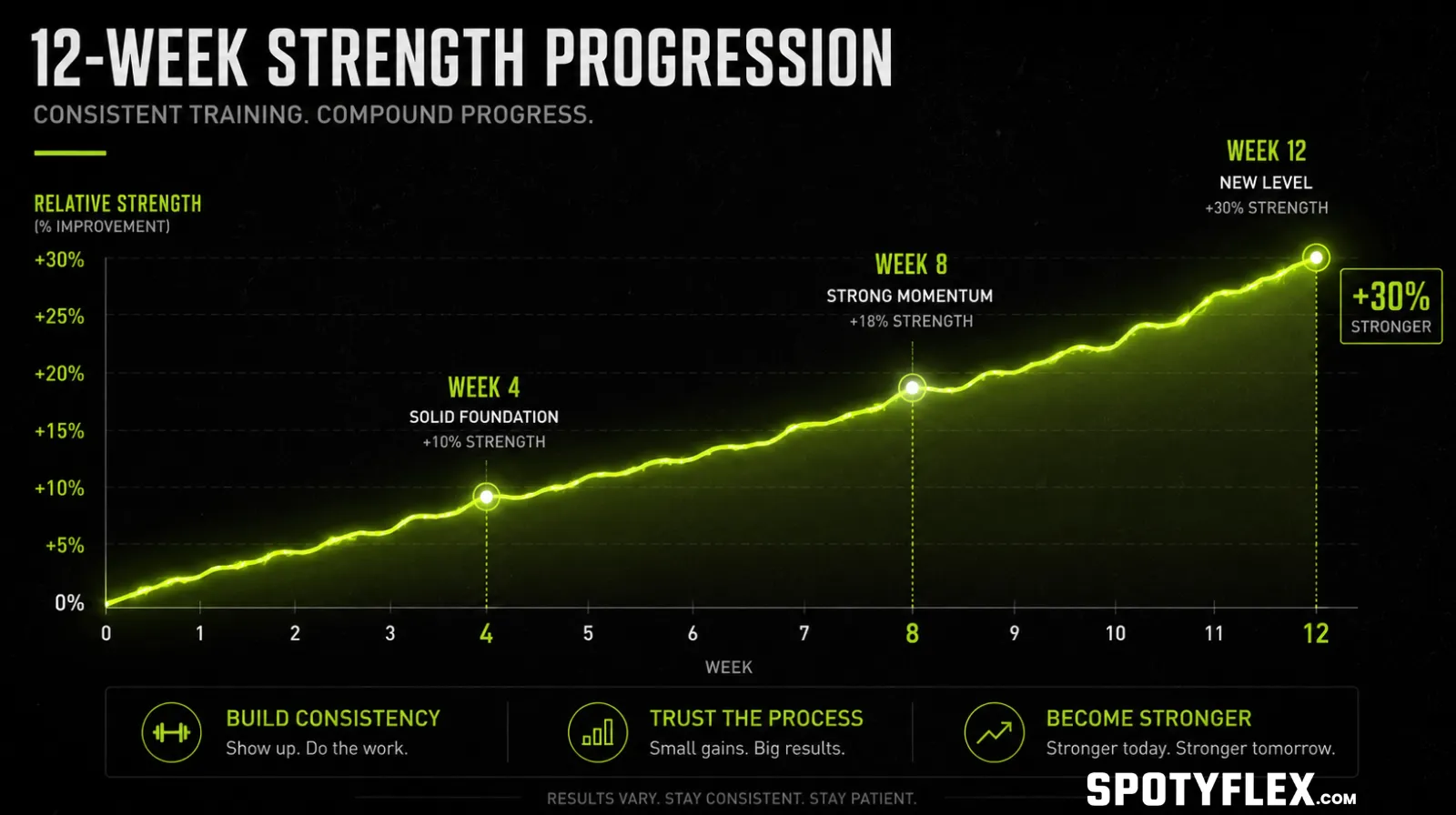
Each week, try to add 2.5kg to your compound lifts or get one more rep on your last set. When you can complete all sets with clean form above the top of the rep range, increase the weight. Log everything.
Common Mistakes to Avoid
Program Hopping
Switching programs every 2–3 weeks because you saw something better online. Most programs work if you run them long enough. Give any solid program 8–12 weeks minimum before judging results.
Skipping Legs
Legs are 50% of your body. They produce the most testosterone and growth hormone stimulus of any muscle group. Skipping legs doesn't just produce an imbalanced physique — it limits your overall results.
Training Without Tracking
If you're not writing down what you lifted, you have no way of knowing if you're progressing. Memory is unreliable. A simple notes app is all you need.
Ignoring Form for Weight
Ego lifting with poor form builds injuries, not muscle. The muscle doesn't know how much weight is on the bar — it knows tension and stress. Full range of motion with controlled technique beats sloppy heavy lifts every time.
Underestimating Nutrition
You can't build muscle without enough protein and calories. You can't lose fat without a deficit. The gym creates the demand — food provides the material. Neglect either side and results will stall.

The Bottom Line
Building a workout routine from scratch isn't complicated. It just requires you to stop overthinking it and start making decisions.
Pick your goal. Choose a frequency you'll actually stick to. Pick a split that matches it. Build your sessions around compound movements. Apply progressive overload every single week. Recover properly. Fuel your training with enough protein and calories. And run the program long enough to see what it actually does.
That's it. That's the whole framework. Every advanced training concept you'll ever read about is a refinement of these fundamentals — not a replacement for them.
The best routine you'll ever have is the one you're actually doing, consistently, with intent. Start there.
Frequently Asked Questions
Sources & References
- Schoenfeld, B.J. (2010). The mechanisms of muscle hypertrophy and their application to resistance training. Journal of Strength and Conditioning Research, 24(10), 2857–2872. PubMed
- Ralston, G.W., et al. (2017). The Effect of Weekly Set Volume on Strength Gain: A Meta-Analysis. Sports Medicine, 47(12), 2585–2601. PubMed Central
- Krieger, J.W. (2010). Single vs. multiple sets of resistance exercise for muscle hypertrophy: a meta-analysis. Journal of Strength and Conditioning Research, 24(4), 1150–1159. PubMed
- American College of Sports Medicine. (2009). Position Stand: Progression Models in Resistance Training for Healthy Adults. Medicine & Science in Sports & Exercise, 41(3), 687–708. PubMed
- Helms, E.R., et al. (2014). Evidence-based recommendations for natural bodybuilding contest preparation. Journal of the International Society of Sports Nutrition, 11, 20. PubMed Central
- Colquhoun, R.J., et al. (2018). Training Volume, Not Frequency, Indicative of Maximal Strength Adaptations. Journal of Strength and Conditioning Research, 32(5), 1207–1213. PubMed
- Phillips, S.M., & Van Loon, L.J. (2011). Dietary protein for athletes: From requirements to optimum adaptation. Journal of Sports Sciences, 29(S1), S29–S38. PubMed

/1.webp)
