



You've seen it before. Someone is consistent — hitting the gym 4 days a week, tracking calories, sleeping okay — and the scale barely moves. Or worse, they start holding fat around their belly even though nothing in their diet changed.
The missing variable almost nobody talks about? Cortisol.
This isn't a "stress is bad" article. This is a breakdown of exactly how your stress hormone hijacks your metabolism, stores fat in the worst place, and what you can actually do about it — without quitting your job or meditating for an hour a day.
What Is Cortisol (And Why It Exists)
Cortisol is a steroid hormone produced by your adrenal glands. Its main job is to help you survive short-term threats: it raises blood sugar, sharpens focus, suppresses inflammation, and gives you energy to fight or run.
In the short term, that's useful. You're about to give a presentation? Cortisol spikes. You're sprinting away from a dog? Cortisol spikes. These are temporary bursts with a clear end point.
The problem is modern stress doesn't have an end point. Work deadlines, financial pressure, poor sleep, overtraining, arguing online — your body treats all of these like physical threats and keeps the cortisol tap dripping, all day, every day.
What Chronic Cortisol Does to Your Body Composition
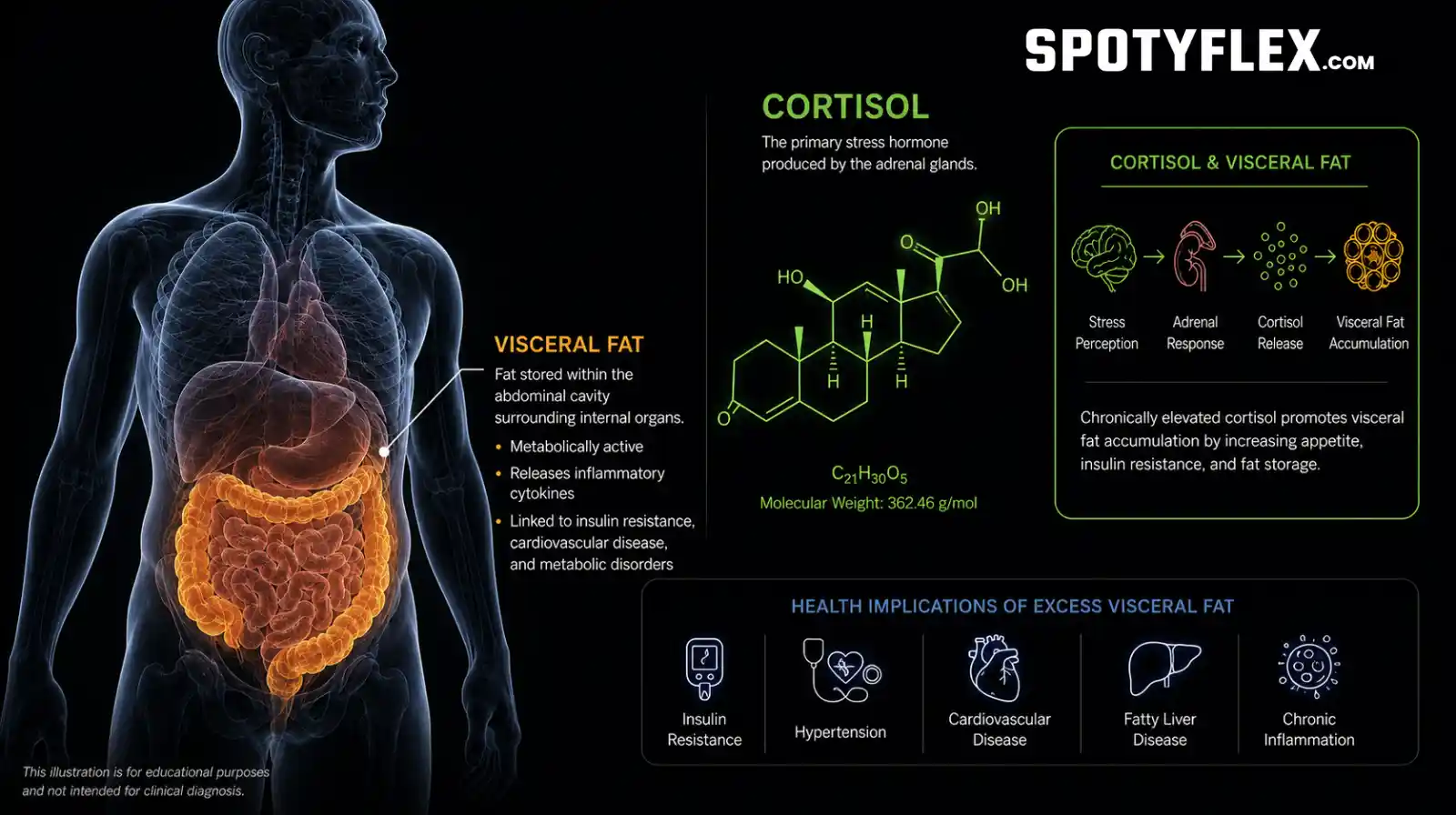
1. It tells your body to store fat — specifically in your belly
Visceral fat has a higher density of cortisol receptors than anywhere else on your body. When cortisol is chronically elevated, your body actively moves fat storage toward your midsection — even when you're not particularly overweight overall.
2. It breaks down muscle
Cortisol is catabolic. When elevated long-term, it breaks down muscle protein and converts it to glucose. Lower muscle mass = lower metabolic rate = harder fat loss.
3. It spikes your hunger — especially for junk food
High cortisol directly increases cravings for high-calorie, high-sugar, high-fat foods. This isn't a willpower failure. It's a hormonal response: your body genuinely believes it needs emergency fuel.
4. It tanks testosterone and growth hormone
Cortisol and anabolic hormones are in direct competition. When one goes up, the others go down. Chronically high cortisol suppresses testosterone production and blunts growth hormone release — you train hard, recover poorly, and make less progress than you should.
5. It causes water retention
Cortisol acts similarly to aldosterone — it tells your kidneys to hold onto sodium and water. The result: you look and feel "puffy," the scale doesn't move, and you assume your diet isn't working when it actually is.
The Cortisol + Calorie Deficit Trap

An aggressive calorie deficit is itself a stressor. Eating 1,000+ below maintenance, combined with heavy training 5–6 days a week and 6 hours of sleep, puts your body in a state of chronic physiological stress. Cortisol goes up. Muscle breakdown accelerates. Cravings spike. You white-knuckle it for 3 weeks and binge. Sound familiar?
The smarter approach: a moderate deficit (300–400 kcal/day) combined with intentional stress management. Slower fat loss, but you keep your muscle, your sanity, and you can actually sustain it. See our complete calorie deficit guide.
Signs Your Cortisol Is Too High
- Stubborn belly fat that won't shift despite eating well and training consistently.
- Waking up tired even after 7–8 hours — elevated morning cortisol disrupts deep sleep.
- Intense cravings at night for sugar, salt, or dense carbs — a classic cortisol-driven hunger pattern.
- Poor gym performance when life is stressful, even if your program hasn't changed.
- Feeling "wired but tired" — alert and anxious in the evenings, crashed and foggy in the morning.
- Slow recovery — muscles sore for 3–4 days after sessions that should recover in 1–2.
How to Lower Cortisol Without Quitting the Gym

Fix your sleep first — everything else is secondary
Cortisol follows a natural rhythm: it peaks in the morning and bottoms out at night. Consistent poor sleep breaks this cycle completely, leaving you with elevated cortisol throughout the day. Read: sleep and muscle recovery.
Add low-intensity work — don't just grind
High-intensity training spikes cortisol acutely — that's normal. The problem is doing 5–6 high-intensity sessions a week with no lower-intensity work. Replacing 1–2 sessions with Zone 2 cardio significantly lowers chronic cortisol. See: Zone 2 cardio guide.
Eat enough carbohydrates
This surprises people. Low-carb diets combined with high training volume chronically elevate cortisol. Carbohydrates blunt the cortisol response after exercise and support serotonin production. Don't eliminate them entirely while training hard.
Hit your protein — but also eat enough overall
Undereating protein while stressed accelerates muscle breakdown. Aim for 1.6–2.2g per kg of bodyweight. And don't undereat total calories — the stress of chronic undereating is real and measurable. See: protein needs guide.
Supplements with actual evidence
- Ashwagandha (KSM-66, 300–600mg/day) — reduces serum cortisol by 20–30% in multiple RCTs.
- Magnesium glycinate (200–400mg before bed) — regulates the HPA axis, supports sleep quality.
- Phosphatidylserine (400–800mg/day) — blunts exercise-induced cortisol spikes in trained athletes.
- Vitamin C (1–2g/day) — adrenal glands have the highest vitamin C concentration in the body; depletion correlates with elevated cortisol.
The Practical Protocol: One Week to Reset
- Sleep 8 hours, same time every night. Blackout curtains, no screens 30 min before bed, room under 19°C.
- Cap training at 3–4 sessions. Replace the rest with 30-minute walks. You will not lose muscle. You will lose cortisol.
- Eat at maintenance calories. Not a surplus, not a deficit. Let your body stop treating food as scarce.
- Take magnesium glycinate at night. 300mg, 30 min before sleep. Notice your sleep quality by day 3.
- No phones for the first 30 minutes after waking. Morning cortisol naturally peaks here — don't amplify it with social media.
- One 20-minute outdoor walk, daily. Morning light resets your cortisol rhythm and supports melatonin production at night.
- Track how you feel — not the scale. After 7 days, assess sleep quality, energy, gym performance, cravings. These shift before the scale does.

The Bottom Line
Fat loss is not just calories in vs. calories out. That's the foundation — but cortisol is the variable that explains why two people eating the same deficit, running the same program, get wildly different results.
If your stress is high, your sleep is short, and your training is brutal, your hormonal environment is actively working against you. You don't need to train harder. You need to recover smarter.
Fix your sleep. Moderate your training intensity. Eat enough. The fat loss you've been chasing will start moving again — not because you added more, but because you finally stopped stressing your body into survival mode.
Sources: Epel ES et al. (2000). Psychosom Med. · Leproult R, Van Cauter E. (2010). Endocr Dev. · Dhabhar FS (2014). Ann N Y Acad Sci. · Chandrasekhar K et al. (2012). Indian J Psychol Med. · Starks MA et al. (2008). J Int Soc Sports Nutr.
/1.webp)
